


Our earliest ancestors engaged primarily with local knowledge.
When they received new information, they knew exactly where it was coming from and why it was being shared.
We must now grapple with heavy flows of information from all over the world, but with minimal or competing context. We can access more “news” than ever before, but we’ve never known less about the sources or their motives.
For both hunter-gatherers and early agriculturalists, information gathering was largely “hands-on.”
But in our era of information overload, we usually receive most of our information from institutions that are foreign to our households, communities, or even our nations.
We know little of their goals or incentives, and yet we trust them.
It often feels like there is no other choice.
But without more context, without truly understanding why we are being provided with which information, it has become impossible to make sense of our modern world.
What does it all mean?
There are too many different sources of information and, to make matters worse, they often conflict. Human knowledge has become severely disordered.
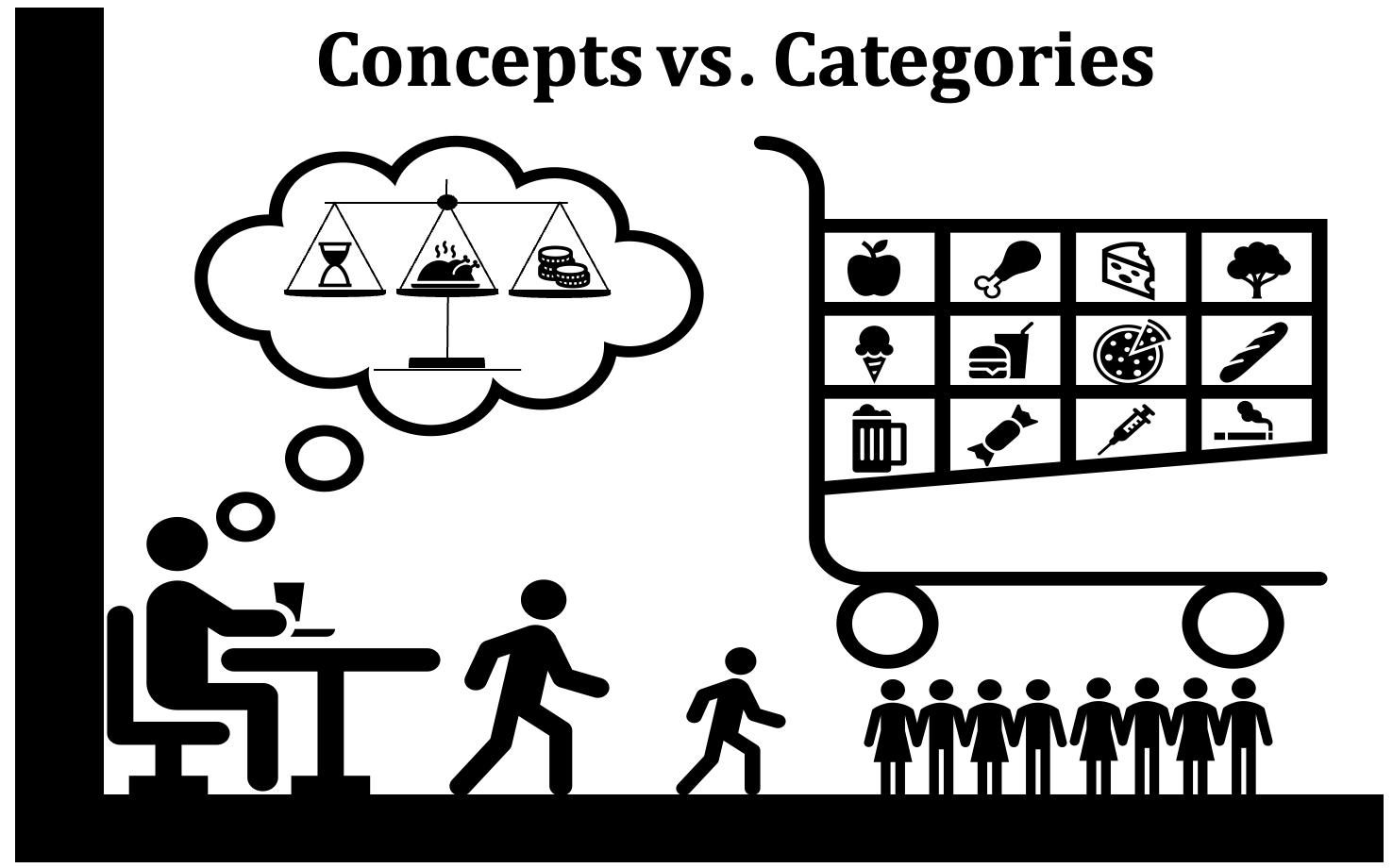
Our transition from hunter-gatherers to agriculturalists irreversibly shifted human life from an “algebra” of two “variables” — Time and Food — to an “algebra” of three: Time, Food, and Money.
From here, our lives have only become more complicated.
As the most cognitively overburdened species, our deep need to organize the knowledge gained from nature led humans to begin categorizing things.
“Categories” are divisions within a system of classification. They are how our minds organize information.
By grouping together related aspects of the external world, our species could better process and store the massive flows of new information brought about by the First Agricultural Revolution.
Only by categorizing and sub-categorizing could our minds handle these new cognitive challenges.
For example, “salmon” is a sub-category of “fish”, which is a sub-category of “animal”. A “fish taco” is a sub-category of “Mexican Food”, which is a sub-category of “Food”. But salmon is also a sub-category of Food.
Systems of categorization allow our species to manage the specificity with which we think and communicate.
At the highest level of detail is scientific language. Here, salmon is not merely salmon. There is “Salmo salar” (Atlantic), “Oncorhynchus tshawytscha” (Chinook), “Oncorhynchus kisutch” (Coho), “Oncorhynchus nerka” (Sockeye), among others.
Scientific language operates alongside everyday speech but is typically only used by specialists. For most people, simplicity is more important than scientific precision. We want other people to understand us.
Categorizing and sub-categorizing our external world facilitates more efficient and effective communication between humans. But before Time, Food, and Money can be explored as concepts, we must first distinguish concepts from categories.
Each term relates to a distinct way of thinking.
To think “conceptually” is to evaluate something in and of itself against some guiding criteria. This involves determining how well something meets the criteria, which allows us to consider and rank many different options.
To think “categorically” means determining whether something falls into a category, without regard for how well.
With “conceptual” thinking, the criteria of evaluation are multi-faceted and must be fully engaged with, but “categorical” thinking requires only the information needed to assign things to their categories.
Both conceptual (slow) and categorical (fast) thinking are vital to how humans develop and retain our understanding of the external world. The difference between them is best understood by considering the following two questions:
Is something “Food” because we eat it? OR
Do we eat things because they are “Food”?
The problem may seem obvious, but can you tell which question relates to which mode of thinking?
With the first question, the meaning of “Food” would have to be subsumed by, and exclusively confined to, a category: things that we eat. This may be an accurate description, but it would be an absurd definition.
Things do not become Food simply because we eat them.
This is among the earliest bits of knowledge that new parents work to instill in their children: putting something into your mouth does not make it Food.
Only the second formulation makes any sense. What humans choose to eat is determined by our conception of Food. In the first question, Food is a category. In the second question, it is a concept.
Assigning the label “Food” to anything that humans eat, no matter what it is, would be categorical thinking. But to think conceptually about Food requires asking:
Why do we eat? What are our goals?
And finally, which Foods best serve these goals?
All humans require Food to survive, but we often think of Food in different ways, and for different reasons. Assigning items to broad categories is very different from prioritizing categorized items because the latter task requires more detailed criteria.
To move beyond categorization and categorical thinking, the specific meaning of each conceptual “variable” must be well understood.
This is the aim of Part I, which will introduce Time, Food, and Money, as concepts.