


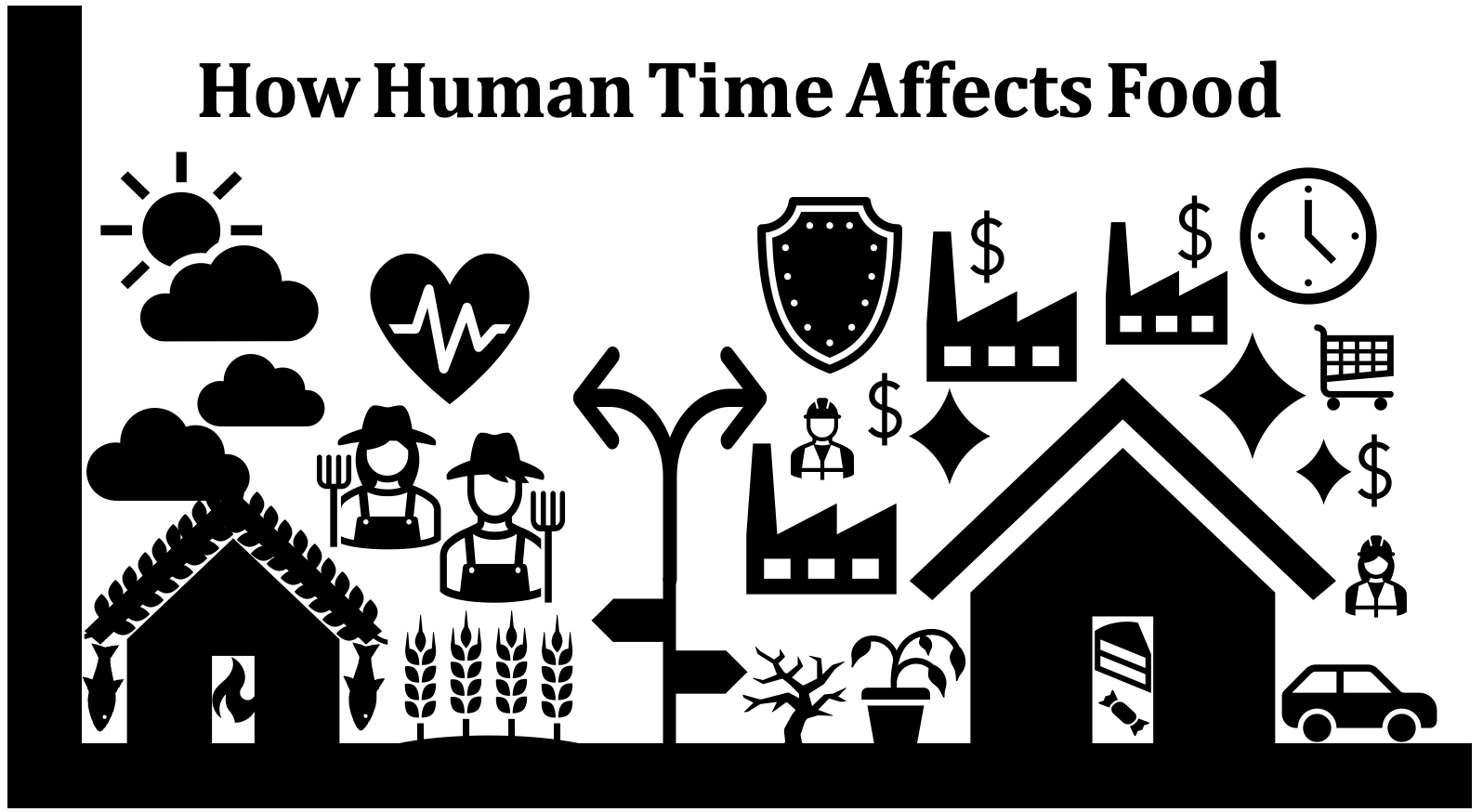
Traditional Foods are rarely provided by nature in ready-to-eat form.
From learning to cook meat to mastering traditional preservation methods, our species has displayed great ingenuity when it comes to Food.
It’s been more than a million years since we mastered fire, which made a big difference. Without the nutrition unlocked by cooking, our brains and bodies could not have developed as they did over the ensuing millennia.
The average human brain was approximately 10-15% smaller by the First Agricultural Revolution. Yet, it was organizing itself in many new ways.
Pottery was another major milestone, enabling the boiling of liquids and storage of grains. The global spice trade, while undoubtedly about Money, was also a transmitter of flavor and preservation methods.
After the Second Agricultural Revolution brought Food into much closer relation with Money, our species further intervened to defend it from the passage of Time.
By inventing canning in 1810 and mechanical refrigeration several decades later, our species pioneered new ways for Food to overcome both Time and space.
Louis Pasteur then helped us overcome bacteria.
From here, our attention shifted from survival to efficiency.
In the 1870s, larger commercial flour mills began to replace traditional stone, and the first refrigerated railcars began to transport perishable Food items from America’s heartland to its coasts. Meat slaughtered in Chicago could now be sold in New York.
This was highly advantageous for a young nation with a growing population to feed — but it also hastened the disconnect between the production and consumption of our Food.
As new technologies were enhancing operational efficiency, new corporations were formed to pursue legal and economic efficiency.
One purpose of using a corporation to produce Food is to protect the human owners’ personal assets in the event their products are found by a court to have caused harm.
There may be good reasons or intentions behind such a system, such as to facilitate the sharing of risk — but it can also be abused if profits are blindly pursued.
On a positive note, the Haber-Bosch Process was invented in 1909 by two German chemists and was arguably the most important innovation of the twentieth century. Synthetic fertilizer massively expanded the global productivity of agriculture.
For the rest of the century, however, most Food innovation happened within corporations, behind closed doors, strictly for the purpose of making Money.
From the owners’ and directors’ perspective, the corporate legal form was critically important because it shielded their personal assets from harsh legal judgments in the event that a court found their products or actions to have caused unreasonable harm.
This legal innovation is also what had enabled European merchants to pool resources when funding risky overseas trading ventures — while minimizing their personal financial exposure.
But by overcoming nature in this way, the stage was set for many new players to enter and expand the growing chasm between nature and our stomachs.
Corporations will be explained in more detail in Chapter 5 (Time & Money).
And their modern application of science and law to the production of Trade Foods will be further addressed in Chapter 6 (Food & Money).
But throughout our species’ history, long predating corporations, there have been many Food innovations that are absent from modern history books or grocery stores.
Traditional human cultures were practicing nutritional innovation long before the Renaissance, Scientific Revolution, Enlightenment, and Industrial Revolution.
For example, the Gaelic communities of Scotland’s Outer Hebrides relied on the thatched roofs of their traditional “black houses” for more than just shelter — it became a powerful fertilizer for a region with harsh growing conditions.
By allowing smoke to slowly filter through their straw thatch roofs rather than a chimney, the chemicals released from burning locally abundant peat moss were absorbed by the straw over the course of a year.
The annual harvest and replacement of the thatched roof was an important part of their culture which served vital, biological purposes.
To the Scottish authorities in Edinburgh, however, this practice was neither efficient nor sanitary. Some officials even blamed the “black houses” for poor health outcomes.
But once modern building codes were introduced that made chimneys mandatory, the yields from traditional oat crops plummeted — these ancient Gaelic communities were then forced to rely on imported Trade Foods such as white flour and sugar.
Some elders has sensed the problem and continued to maintain their “black houses” alongside their government-sponsored modern homes, but the damage was done.
Despite costly government efforts to modernize these communities’ traditional living conditions, the result was a rapid deterioration of community health outcomes.
The traditional application of Human Time to secure local nourishment was displaced by centralized decision-making in London and Edinburgh’s government offices — where hired agents used their Human Time to pursue very different goals.
The prejudiced sanitation efforts of Scottish public health officials may have been well-intentioned, but they were also part of a larger imperial plan that had been formed in London.
By incentivizing Scottish landowners, the British State was aggressively pushing commercialization by dismantling traditional subsistence agriculture.
Their goal was to integrate the population into the industrial labor market — they needed human factory workers for their Industrial Revolution, and they succeeded.
After countless millennia of Traditional Food innovation, powerful merchants and landowners began using corporations to harness Human Time for the purpose of Trade Food innovation.
The traditional goal of Food production had been to promote healthy humans and communities — the modern goal was all about Money and healthy profits.
This pattern was exported and replicated around the world by the British Empire, but it was perfected by American corporations in the aftermath of World War II.
In the next post, we’ll explore how large Trade Food producers entered the market for Time by using science to sell convenience.