


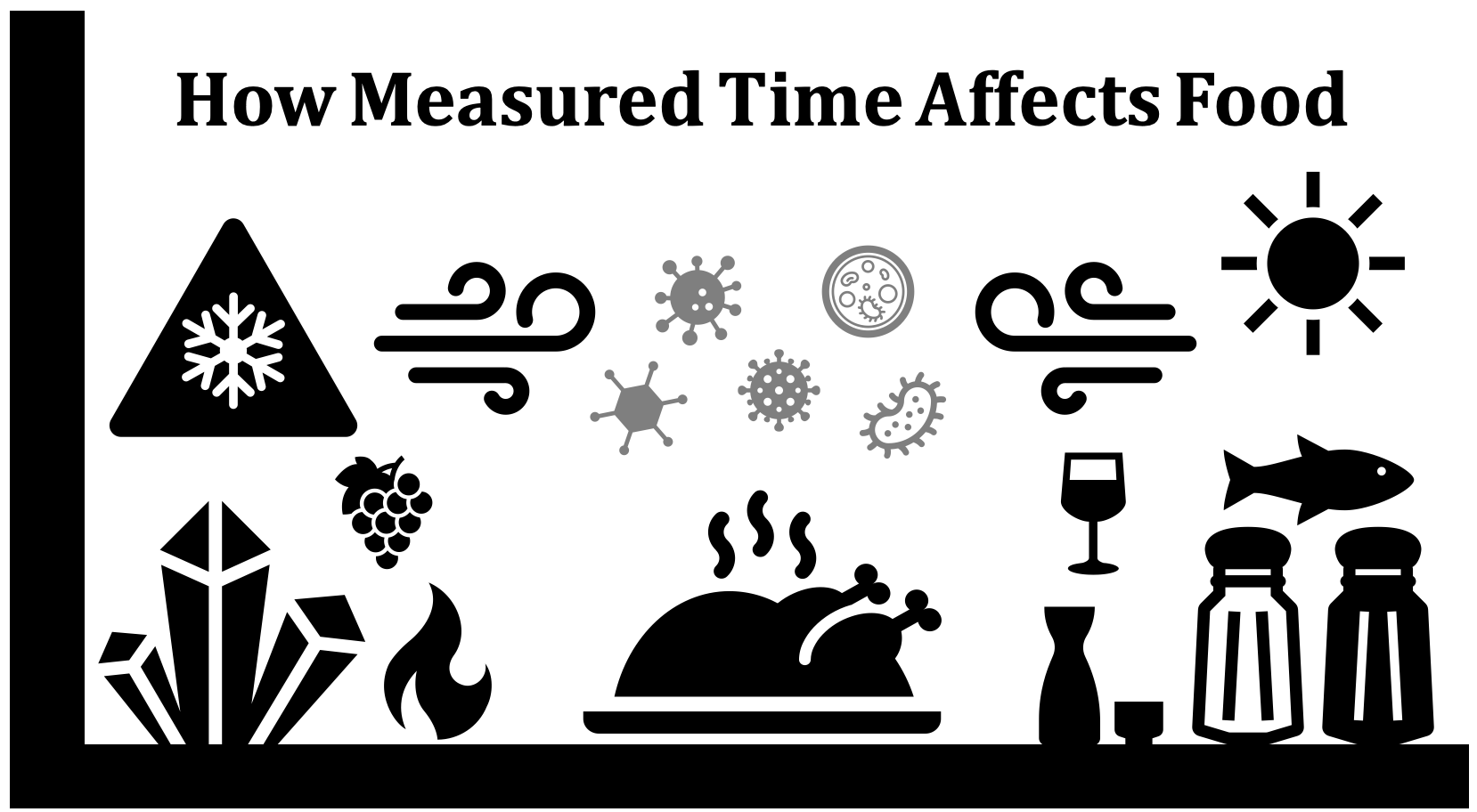
Food spoils with Time.
Whether through invasive microorganisms like bacteria, mold, or yeasts; natural chemical breakdowns within the Food itself; or exposure to environmental factors like air, sun, or moisture — the passage of Time has long been an enemy of nutrition.
This is why humans save Money for retirement. Not Food.
The idea is to preserve our access to Food by using Money as a store of value.
Specialty items like wine or whiskey may appreciate over Time — their Money value increases as they age.
Taste may be affected, but this is also about status. Certain cheeses, vinegars, or dried meats require also aging periods to reach their desired states.
But Food is generally a poor store of value.
The various Food items that functioned as Money throughout our species’ history were all highly resistant to the damaging effects of Time.
For both the Mayans and Aztecs of Mexico, cacao beans functioned as local currency and were used as a medium of exchange.
During China’s Tang and Song dynasties, bricks of dried tea served this purpose.
From Africa to the Americas, many ancient civilizations used salt as Money.
Consumed for both flavor and health reasons, salt was also used to preserve meats and other natural Food, slowing the aging process by defending against microorganisms.
Despite popular misconceptions, salt played no formal role within the Roman Empire’s systems of Metallic Money. Apart from periods of shortage inherent to such systems, Roman soldiers were typically paid in metal coins.
But salt was a critical ration for Rome’s armies — which is why their allowance of coins for buying salt and other necessities became known as a “salarium.”
How the need to feed traveling armies shaped the history of Money will be explored in Chapter 6 (Food & Money).
Salt symbolizes the relationship between Time and Food better than any other substance. And unlike many newer preservatives, it is absolutely vital to our bodies.
Chapter 2 introduced salt as the dietary mineral sodium — but its economic role as a Food preservative is no less significant than its biological role within our bodies.
Sugar was introduced as a harmful Food additive whose economic role as a low-cost, high-energy sweetener powered the rise of multiple European empires.
Interestingly, both white powders have been labelled “white gold” by humans.
But for very different reasons.
From the Roman Era through the Middle Ages, salt earned this label on account of its life-giving properties. Powerful city-states like Venice and Munich did monopolize its production to fund war — but this was only possible because human bodies needed it.
Sugar became “white gold” much later, during the Europeans’ seventeenth century colonization of the Caribbean — but for economic reasons instead of biological.
European merchants valued sugar for the Money it could be exchanged for.
By contrast, salt was valued by ancient human cultures for helping navigate Food’s passage through Time, thereby extending our own Human Time.
Every isolated culture studied by Dr. Price relied on traditional Food preservation methods. The Inuit possessed a natural freezer and maritime cultures had ready access to salt, but groups in other areas had to develop alternative methods.
The Swiss villagers and multiple African tribes fermented raw milk into cheeses and other products. Woodland Indians fermented grains and other starches, keeping them fresh for months.
Drying or dehydrating meats using sun and air was also widely practiced.
The purpose of these and other traditional preservation methods was always to keep Food safe to eat in the future. Based on experience, memory, and tradition, ancestral knowledge regarding Food safety was critically important and heavily relied on.
This knowledge base was slowly developed in isolation long before science, grocery stores, Food lobbyists, or government agencies entered the scene.
For traditional human cultures, the idea of Food safety was always about holistic survival, encompassing both the immediate and long-term health consequences for individuals, as well as the biological resilience of the community.
Methods for preserving Traditional Foods were slowly developed in tandem with biological feedback from our bodies and communities.
The standard was health.
Traditional Foods weren’t being preserved to expand the window of Time that they could be traded for Money (“shelf life”) — it was to expand the availability of nutrients to human bodies and communities.
Things are very different now.
As our species shifted toward Trade Food, science and technology were deployed by large corporations to make their Food products more profitable to sell.
Methods for preserving Trade Foods were rapidly developed in tandem with economic and legal feedback from shareholders and corporate directors.
The standard became Money — any connection to our biological systems would have to be established in a court of law, where science is often highly politicized.
This topic will appear again in Chapter 6 (Food & Money), but this difference between Traditional and Trade Food has major implications for the Time & Food dualism.
Humans have traditionally sought out methods for making Foods safe to eat.
Large corporations are concerned with producing Foods that will remain safe to sell.
These are, unfortunately, different goals.
To understand why, we must explore the meaning of “Food Safety.”