


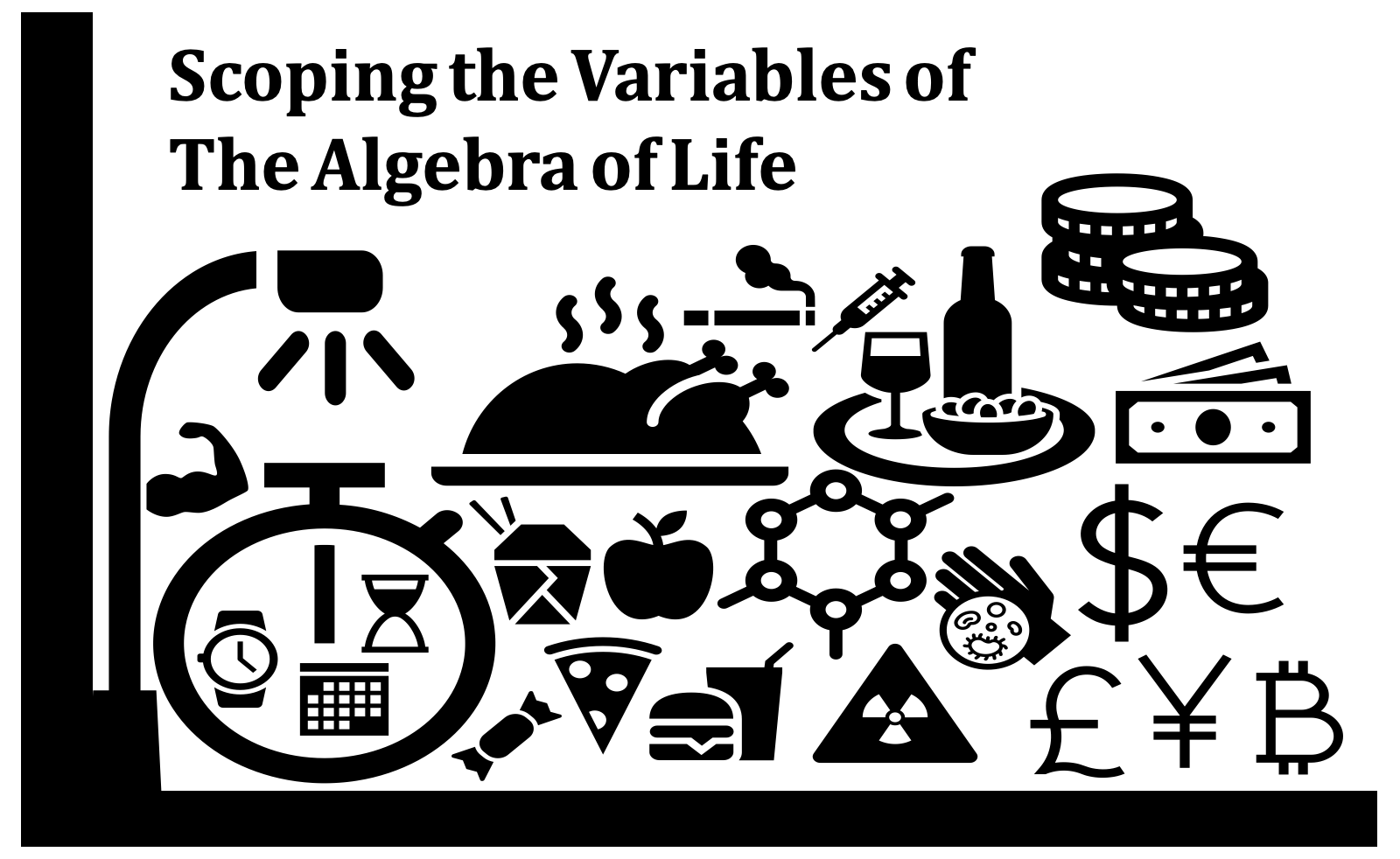
Can human life really be reduced to three variables?
Isn’t there more to our lives than Time, Food, and Money?
These are reasonable questions.
But these variables are concepts rather than forms, which makes each domain far more all-encompassing.
Our “Time” is not just the measurable duration of our existence —a human invention— but also our non-observable experience of life itself — the human condition.
This is “Human Time”.
Measured Time is simply a matter of duration, but Human Time is rooted in our consciousness. It captures both how we feel — you can have a “good” or a “bad” Time — as well as how we manage Time as a resource.
We may “sell”, “spend”, “invest”, or “waste” it, but unlike with Food or Money, we cannot store our own Time for future use.
Your Human Time is a one-way street with no turning back.
Once it ends, it’s over.
Food or Money may be provided to you by others, but Time does not work like this.
When someone “gives” their Time, it does not add to anyone else’s lifespan. If you “buy” someone’s Time, you are only buying the right to direct how it is used.
This biological constraint is a great equalizer between the rich and poor when it comes to duration, as maximum human lifespans have changed little over the millennia.
We all eventually die.
But while finite in duration (Measured Time), the human life experience (Human Time) represents an ocean of unimaginable depth and diversity.
It is universally accessible, but our Human Time can only be experienced individually.
Avoiding pain, pursuing pleasure, bearing responsibility, forming ideas, falling in love, raising children, sleep, exercise, and all social relations; each of these topics and many others fall within the domain of Time.
Food and Money are subordinate, relating to eating and drinking, and buying and selling, respectively.
Ever present in our lives, Time is the most fundamental human concept.
Next is Food.
Within The Algebra of Life, “Food” means everything entering our bodies, whether knowingly or otherwise.
This includes not only breakfast, lunch and dinner, but also snacks, drinks, drugs, personal hygiene products, contaminants, toxins, and air pollution — everything that goes inside of our bodies.
For as long as humans have been experiencing Time, we have required Food.
Without it, our Time runs out.
Humans have spent thousands of years learning what to eat, as well as when, where, and how to obtain it.
We started by hunting and gathering. After harnessing nature to our advantage, agriculture stabilized our diets and gave rise to cities. As trade intensified, Food began to be shipped globally, expanding our options even further. With modern technologies, many different types of Food are now imported and exported by many different countries.
Our modern global economy makes the British Empire’s once-dominant trade network seem quaint by comparison.
Food can now be extracted from the oceans or lands of one country, processed in another, and then transported somewhere else to be combined with other ingredients to form a finished Food product.
Packaged, labelled, and often ready-to-eat, these carefully engineered items are then shipped to grocery stores around the world where they sit on shelves waiting to be hand-selected by a human customer.
It may take some Time to find what you’re looking for, and you might have to wait in line, but modern grocery stores and markets do not accept Time for payment.
Food must be paid for with Money.
Hunter-gatherers acquired, prepared, cooked, and ate their Food with their own hands.
Today, however, most humans are only directly involved with eating and possibly cooking. We might select Food items from grocery store shelves with our hands, but most of the real work has already been done.
The price we pay in Money includes the cost of this preparation.
Within The Algebra of Life, Money is defined as how humans intermediate between Time and Food, regardless of the physical form or legal basis of the Money.
Most countries have their own standardized forms of Money that fit seamlessly into a global financial system, but this was not always the case. Money has taken many different forms, from seashells and feathers to metals and paper, and has had varying levels of involvement from central authorities.
These things will be explained later.
For now, what must be recognized is that the meaning of Money as a concept, to modern humans, runs far deeper than any specific form, legal system, or governmental authority.
But humans are not the only entities transacting in Money, and this has further distanced us from our hunter-gatherer heritage:
Our species’ consumption of Food has become increasingly disconnected from its production.
As non-living transacting entities, corporations are central to this phenomenon.
Previous Post: Why Money Belongs Alongside Time & Food in The Algebra of Life
Next Post: Corporations: Where the Variables of Human Life Mean Something Different