


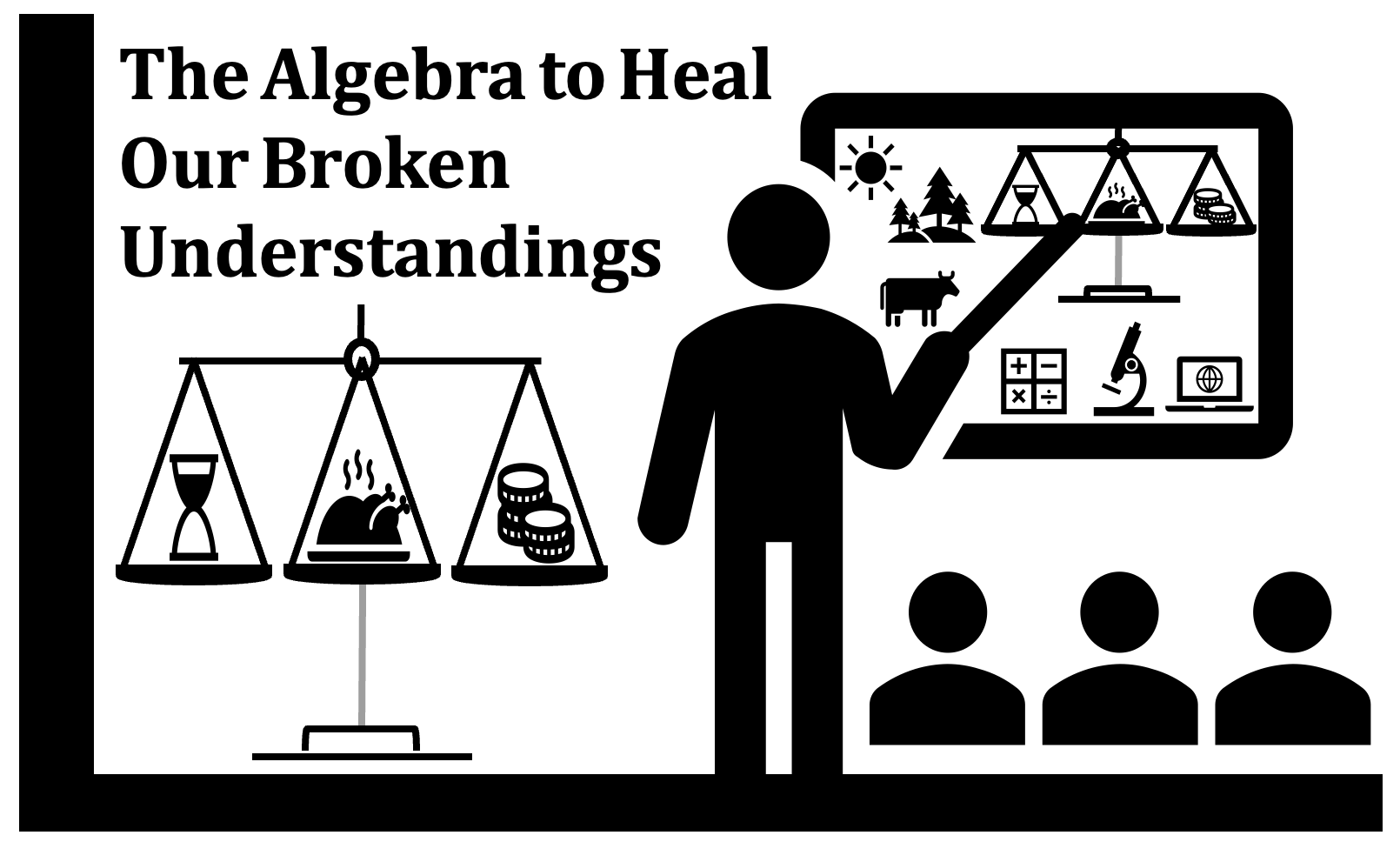
More than mere words, “Time”, “Food”, and “Money” are the three principal concepts which weave together the fabric of modern human existence.
We all know their meaning, generally, but behind each word lies great conceptual depth.
Time seems simple enough.
We measure it with a clock. But our experience of it, particularly our consciousness, is a longstanding mystery.
Food also appears straightforward.
We all eat.
But what counts as Food? What is best to eat?
Scientists have generated conflicting information, and warnings about dangerously unhealthy Food additives have been conspicuously late or absent altogether.
There is also more to the concept of Money than meets the eye.
We all know what it is, but where does it come from?
The simple answer for many is that it comes from their employer, their customers, or possibly from the government. But this is only where their Money comes from, or from whom they received it.
Amidst our modern social complexity, we lack a sufficiently detailed or unified understanding of these concepts. This has caused a slow buildup of fragmented and imprecise knowledge, impairing our decision-making ability in all three domains.
The word “algebra” comes from the Arabic “al-jabr”: “reunion of broken parts”. Associated with mathematics today, the term originally referred to bone setting or the surgical treatment of fractures.
The Algebra of Life is different from “solving for X.”
Our collective understandings of Time, Food, and Money have been fractured and obscured by complexity.
The Algebra of Life was developed as a remedy to this confusion.
Only by reuniting these three “parts” within our minds — by thinking of Time, Food, and Money together instead of in isolation — can we heal our broken understandings.
To make sense individually, “Time”, “Food”, and “Money” must be considered jointly by exploring the two-way interrelations between each pair of concepts.
This publication will not spell out how to use your Time, which Foods to eat, or how to spend your Money. The goal is to advance your conception of human life, and the role of Money within it, for the purpose of making better decisions.
To “solve” the Algebra of Life is to master each domain so that decisions can be optimized across all three.
But since we face endless decisions and possibilities in our modern world, a final “solution” will remain elusive.
We only have so much Time.
There is only so much we can do.
But we can learn to make better decisions, by peeling back the layers of social complexity that have long shrouded the true nature of our species’ existence.
Life does not have to be so complicated.
Part I will introduce Time, Food, and Money as individual concepts.
Food must take a physical form, while Money may manifest physically, but Part I is concerned with these words as concepts.
How concepts interact with each other is less scientifically navigable than interactions between physical matter, and this makes Part II more of an art than a science.
But it remains critical to first isolate the individual meanings of “Time”, “Food”, and “Money”, respectively, before turning to their interactions.
This is the aim of Part I.
Part II will treat these concepts as dualisms, exploring their two-way interactions.
Academic philosophers describe dualisms as theories of reality which consist of two irreducible elements — such as mind and body, or spirit and matter.
The Algebra of Life deals with more practical matters.
Its variables form three dualisms: Time & Food (Chapter 4), Time & Money (Chapter 5), and Food & Money (Chapter 6).
Each pair invokes numerous, distinct areas of life.
How do the Foods we eat affect our Time?
How does our use of Time affect our Money?
How does our use of Money affect our Time?
By carefully considering these and other related questions, you may change how you see the world and your place within it.
Part III will apply our exploration of the three dualisms to everyday modern life.
The dualistic framework of “Time and Food” might fully capture the life and decision-making of animals, but we are humans.
As the only life form to intermediate between Time and Food, the “algebra” of modern human life contains a third variable: Money.
The Algebra of Life will be introduced as a framework to help make sense of our lives and world, for the purpose of making better decisions in the domains of Time, Food, and Money (Chapter 7).
Previous Post: Corporations: Where the Variables of Human Life Mean Something Different
Hello. I just found your publication and I love it. What a unique name and perspective. Very creative. I find your topics very much in alignment with my values. I look forward to reading more of your posts.