


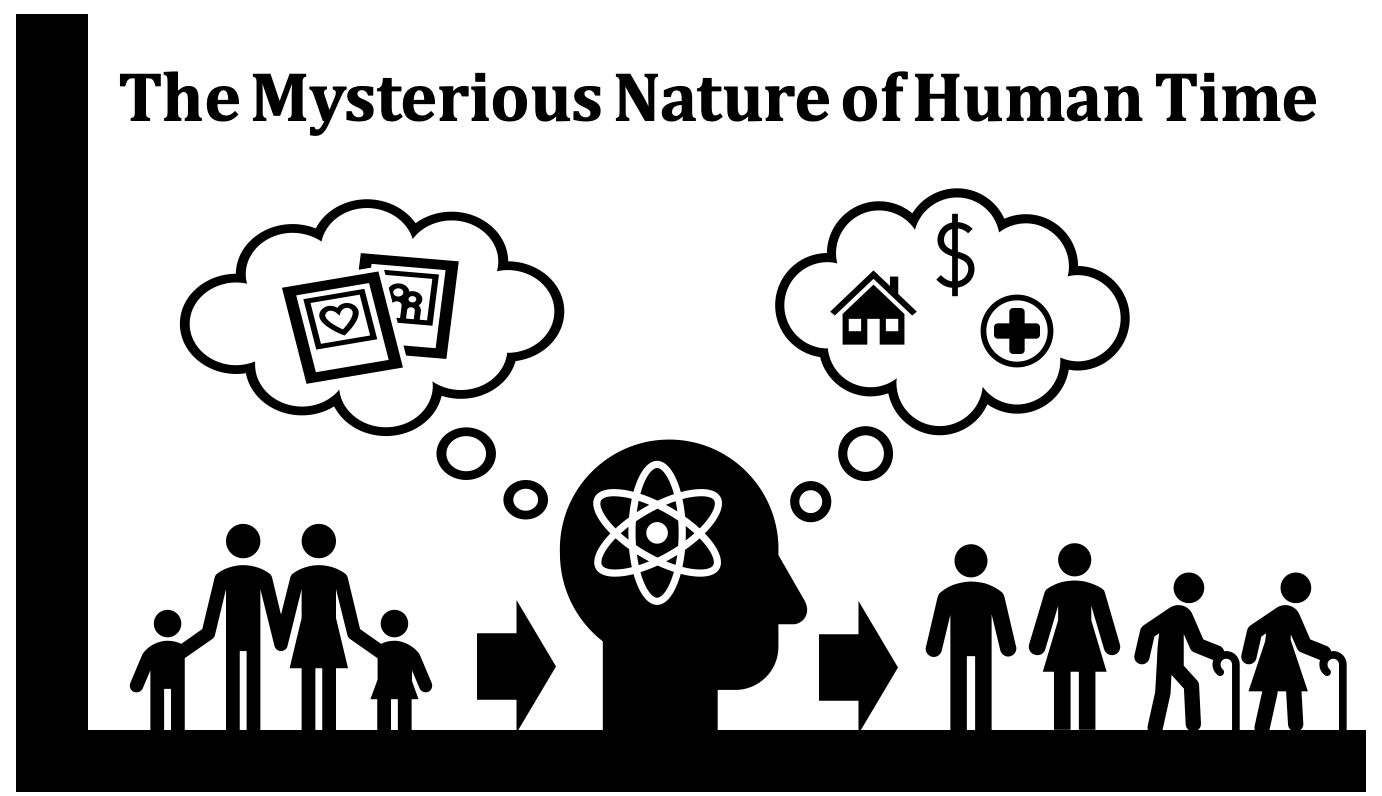
Unlike Measured Time, which humans have mastered through science and technology, Human Time is among the least well understood aspects of our existence.
We have inherited many different branches of specialized knowledge to help us understand and explain the external world, but reliable knowledge about our internal worlds is much harder to come by.
Treating broken bones is different from treating a broken heart.
Human consciousness remains a scientific mystery due to problems of observation and measurement. Applying scientific methods to our minds is exceedingly difficult because of the mysterious nature of Human Time.
The shortcomings of various academic fields can be traced to this concept.
Within economics, the void left by the omission of Human Time was filled by another of Adam Smith’s creations — the concept of the “rational man.”
Smith conceived the idea of an all-knowing, all-calculating, Money-oriented and perfectly self-interested human during The Enlightenment period, fulfilling his desire to apply science to human behavior.
Auguste Compte had a similar desire but, unlike Smith, he believed that isolating a single economic variable — Money — would distort the true science of society. He rejected the “rational man” concept.
By conceiving human nature in this way, however, Smith greatly simplified the math of economics. It could now look more like physics.
But applying science to human behavior is very different from accurately describing it.
And while Smith’s earlier works demonstrate his awareness of this, it wouldn’t matter.
The ideas we inherit are rarely understood or applied as intended by their creators.
Quantifying the non-quantifiable simplifies math while jeopardizing accuracy. But making useful predictions is different from making accurate predictions, and professional economists are generally paid to do the former.
The difference between a useful prediction and an accurate prediction is that the former may still be used to make Money in some way, even if it doesn’t turn out to be accurate.
Think of celebrity sports-betting sponsorships.
Unlike predictions within “hard” science, the creation and distribution of economic predictions is intended to shape the future rather than to foretell it.
Our most famous economic theories use the “rational man” as a workaround for Human Time, but the marketing and public relations firms whose corporate aim is to shape our human beliefs and decisions — they certainly don’t believe in this concept.
They know there is much more beneath the surface.
Human Time is impenetrable to professional economists because its “units” are not measuring units, but cognitive layers: the “past,” “present,” and “future.”
Measured Time can be broken down into standardized, quantifiable units of measurement (e.g., days, hours, minutes, seconds, etc.).
Human Time breaks down into three separate cognitive layers, each a distinct concept.
We may use each terms with reference to Measured Time, but this doesn’t capture what they mean to us as concepts within our minds.
Knowing which day of the week it is, or which month of the year, doesn’t capture our experience of the “present.” How we experience and understand our own “past,” “present,” and “future” is highly emotional and subjective.
We cannot change past events or reliably predict future ones — the laws of physics must be obeyed — but it’s natural for humans to experience their past, present, and future differently.
Our species’ mental worlds are under no obligation to form a coherent whole in the same manner as our shared physical world.
We experience our past through memories: the “remains” left within our minds after an experience. They may be positive, negative, or neutral.
We might deeply regret some past actions while looking back on others with great pride or satisfaction. But unlike the economists’ “rational man,” our minds do not capture “reality” for our later, on-demand use.
They are not video recorders. Life is not Netflix.
We now know that memories are created by our minds. But since Human Time is involved, the specific process remains a scientific mystery.
Past events may be unalterable, but the laws of physics can’t stop us from changing how we feel about them. Since they only exist within our minds, our memories are far more malleable than we may wish to acknowledge.
The contents of our memories may depart significantly from the original experience, adapting themselves for some new purpose.
The “past,” as we experience it in the present, is scientifically uncertain.
The future is uncertain for a more obvious reason: it hasn’t happened yet.
Our memories relate to the past — but our hopes, dreams, fears, and expectations are future oriented. Our memories ultimately relate to certain past events, but these future-oriented feelings relate to our uncertain prospects.
The “present” is not just what separates the past from the future.
It is what separates our past from our future.
It is deeply personal.
Our experience of the present is closely related to another scientifically mysterious concept: human consciousness.
Consciousness implies not just physical presence, but also a state of awareness. And like our experience of Human Time, no two humans can be conscious in exactly the same way, or of exactly the same things.
The concept of Money exhibits a similar paradox as our consciousness: it plays a central role within our lives, and yet we only vaguely understand it — but that is a topic for Chapter 3.
The Algebra of Life will not resolve any longstanding scientific mysteries regarding consciousness. We can, however, explore how consciousness connects our experience of Time, and our consumption of Food, to our physical bodies.