


Part 1: Concepts
“Something conceived in the mind”
“A principle or idea”
“An abstract or generic idea generalized from particular instances”
“An idea of something formed by mentally combining all its characteristics or particulars, a construct”
“A directly conceived or intuited object of thought”
“An idea for a new product or a way to sell a product”
- Selected definitions
Concepts only exist within our minds, but we use them to relate to the external world.
They can be neither touched nor felt, yet they underlie all that we do. Before humans can act, we must think — at least minimally.
Concepts lie at the core of human thought and action. Before an action can be undertaken, it must first be conceived or conceptualized. This is not a matter of prudence, but of possibility.
If we cannot imagine, or conceive ourselves doing something, we simply cannot do it.
To act in the world, we must first believe that we can. This type of thinking must always precede our actions, but this is not what is meant by “think before you speak.”
This warning relates more to the aftermath of our actions: is this the best way to act?
But before choosing an action, we must consider our options.
By conceptualizing the future, our minds discern the range and scope of our possible courses of action and their expected results, based on our experience and imagination. Only then can we decide.
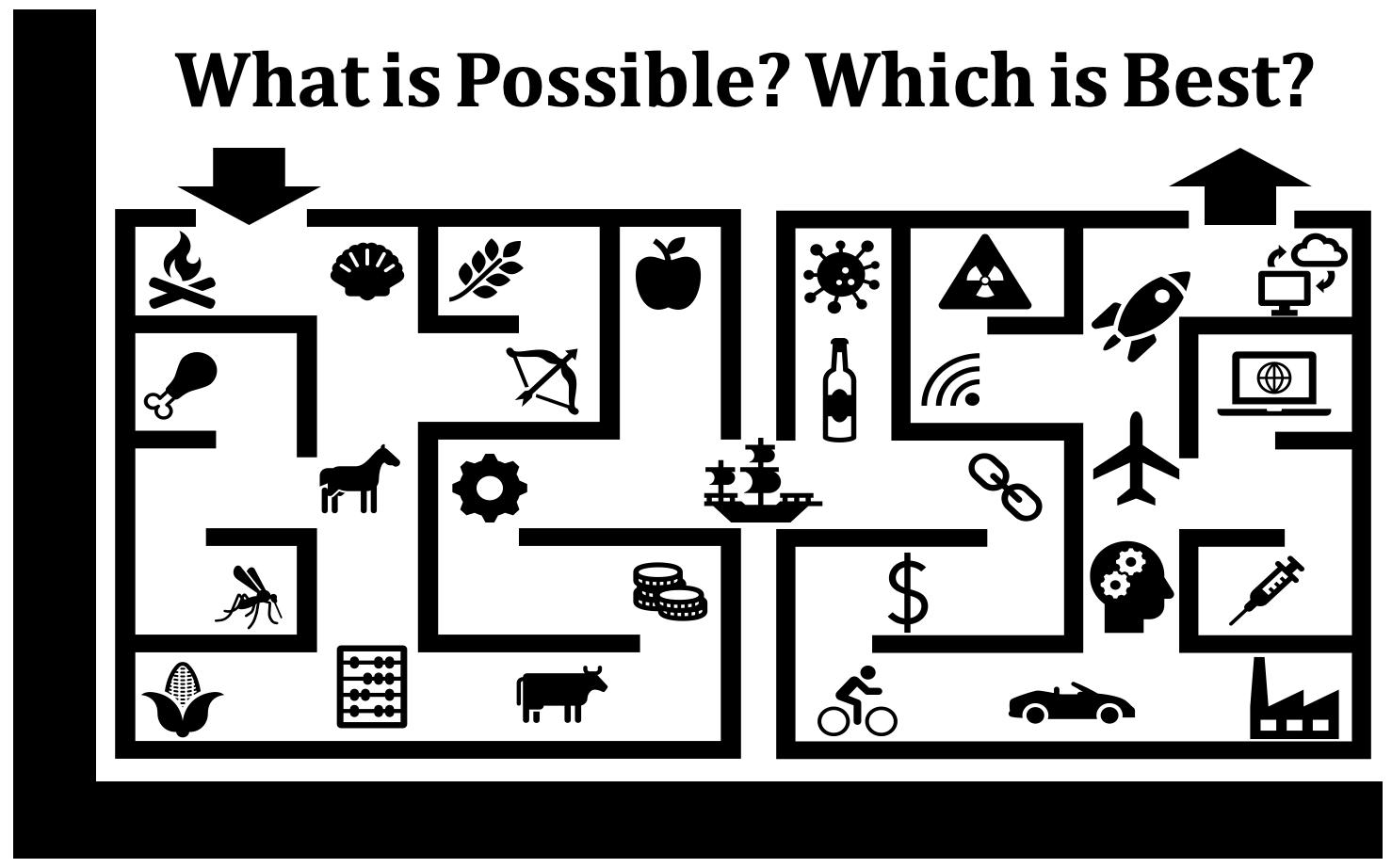
What is possible? Which is best?
These questions are interrelated because the prospect of a bad outcome may cause our minds to generate alternative courses of action. Or the prospect of a good outcome may prevent us from exploring alternatives.
But our decisions can still be broken down into two stages:
(1) Determining the possible courses of action, and
(2) Choosing the best one.
Answering these questions feels so difficult today because of how far we’ve departed from our hunter-gatherer heritage.
At one extreme, we might spend our lives considering every available pathway and never pick one to follow — a life without direction.
Or we might commit to a certain path before we understand the available options.
If the first decision-making stage is performed too hastily, an illusion of simplicity sweeps over the latter: the fewer choices we can perceive in different situations, the more confident we can be in having chosen correctly.
If our perception of what is possible is constrained by a lack of imagination, or for any other reason, we might end up on the wrong path without ever looking back — a misdirected life.
Modern humans must constantly make decisions which impact the “direction” of their lives, but whether we are “living the right way” cannot be confirmed with a compass. We might confidently err in some areas of our lives, hesitantly choose correctly in others, while being paralyzed by indecision in others still.
Without a first-principles system of living, it can be hard to tell how you’re even doing.
The Money we accumulate means something, but not everything.
More than any other life form, humans reflect on their decisions and the subsequent outcomes, with the aim of achieving better futures. We’ve always been pattern recognizers, but many ancient patterns either don’t make sense anymore or have been turned against us.
“Luck” may also be involved — good decisions may lead to bad results and vice versa — but better decision-making generally leads to better outcomes.
We cannot change the past or predict the future, but we can always become better at determining what is possible and choosing which is best.
To answer these questions throughout our history, humans began to think.
To avoid living without direction, and to avoid being misdirected, our species began to think for ourselves. This is our primary defense against pain and suffering, but it can also lead us astray. In our complex world, we may “think” our way into a wide variety of circumstances, both positive and negative, all in one lifetime.
The material world and our productive capacity (“the economy”) have dramatically expanded and are becoming more interconnected. Internally, our brains and minds are also evolving. With each passing generation, our inner and outer worlds develop in tandem, each affecting the other.
Our species and civilization evolve together.
The world changes us, we change the world, and so on. But since we can only live for so long, each child inherits a world they have yet to affect. And their struggle to make sense of it all is vital to our species’ collective learning and development.
To learn is to think in such a way that knowledge is both created and stored for some beneficial future use.
Our earliest ancestors were limited by oral communication and human memory, but communications technology has advanced considerably: writing (~3400 BC), paper (~800 BC), the printing press (~1440), the telegraph (1844), the telephone (1876), email (1971), and mobile instant messaging (2007).
Global digital communication is now seamless and essentially free. Computers enable us to both store and access virtually infinite knowledge. Yet humans remain biologically constrained.
We only have so much Time, and we still require Food.
New technologies will continue to outpace the evolution of our bodies and brains. But even if innovation keeps changing the answers, humans will always be confronted with the same, timeless questions:
What is possible?
Which is best?
Next post: Concepts vs. Categories
Previous Post: The Algebra to Heal Our Broken Understandings