


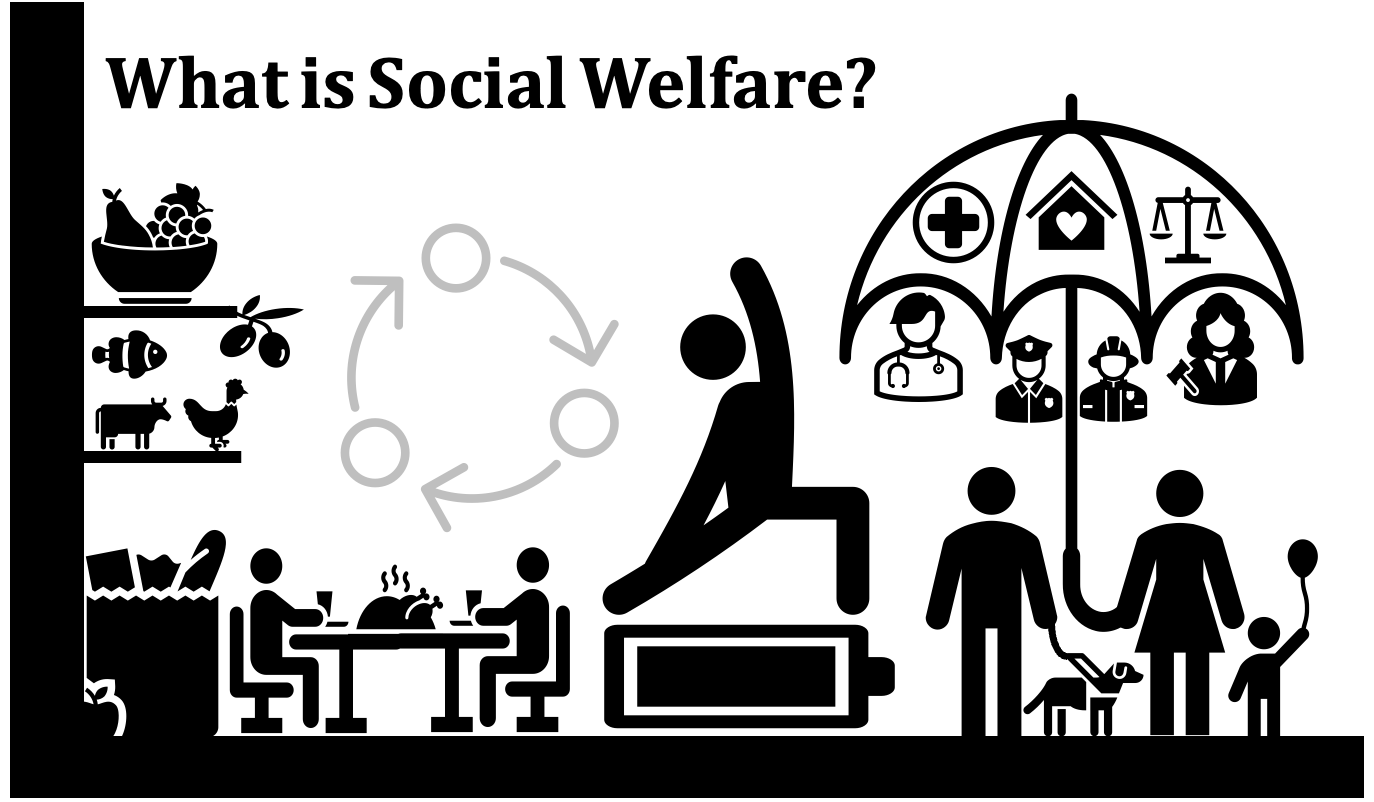
Within The Algebra of Life, the concept of social welfare can be separated into two broad domains: Time, and Food.
Time is what our bodies go through.
Food is what goes through our bodies.
Time is the overarching “variable,” encompassing both the Foods we eat and how we spend our Money. But these are special subsets of the many ways that humans use and experience their Time.
To make better sense of our modern world, we must treat these concepts as three distinct decision-making domains.
When conceived sufficiently broadly, the quality of human life is a direct function of Time and Food, with Money playing an indirect, intermediary role.
We are fortunate to have more control over our Time and Food than animals.
Our species faces many different decision sets and resource constraints, but the choices we make directly affect both what happens to our bodies (how we spend our Time), and what goes inside of our bodies (Food).
Pigou’s conception of economics is brought to life when social welfare is broken down into the domains of Time and Food.
The Algebra of Life involves exploring how Time and Food can be brought into relation, either directly or indirectly, with the measuring rod of Money.
Pigou addressed the thorny issue of economic measurability by considering both the direct and indirect forces. These correspond to the objective (measurable) and subjective (non-measurable) relations between Money and human life.
For example, the price of Food is an objective and direct relation to Money, but the price-driven motivation, or incentive, to buy or sell certain Food items, is a subjective and indirect relation — it happens within our minds.
Money prices are objective because they are external to the human mind and can generally be observed by everyone. The effects of prices, however, are subjective and will be different for different people.
Despite being central to how we conceive our own “social welfare,” how we feel about the amounts of Money we receive for our Time, and which we must pay for our Food, receives minimal attention from professional economists.
Part II (Dualisms) will bridge this gap by exploring both the direct and indirect relations between Time, Food, and Money. Prices themselves, which are objective and measurable, will be distinguished from their subjective and non-measurable effects.
How prices influence our actions is different for each person, but the choices we make in the domains of Time, Food, and Money have profound implications for our social welfare throughout our lifespans.
Within The Algebra of Life, exploring the interrelations between Money and anything else requires considering both the measurable, objective prices and their non-measurable, subjective effects.
When grappling with decisions that may promote or detract from our social welfare, the field of economics may lead us down the wrong path because it cannot adequately consider subjective phenomena such as human motivation and experience.
But sociology does not take Money seriously enough, depriving the field of structure.
When it comes to navigating our increasingly overburdened and expensive lives, we risk being misdirected by economics, and lacking direction altogether with sociology.
The French philosopher who coined the term “sociology” would have been disappointed. Auguste Compte (1798 — 1857) envisioned a “grand science” that would incorporate many disciplines.
He sought to integrate all fields of knowledge into a unified whole, believing that the physical sciences needed to further develop before progress could be made on the more challenging task of using science to analyze human activity.
This vision never materialized for several reasons.
Much of the future advancement of science, particularly regarding human behavior, has been executed by corporations for the purpose of making Money — not to realize some grand intellectual framework.
Human activity and behavior cannot always be measured or observed, which makes it difficult to apply scientific methods.
The Scientific Revolution (1543 — 1687) was aimed at explaining the physical, external world. It greatly enhanced our material condition by expanding our knowledge of the physical world, and of Measured Time.
During “The Enlightenment” (1715 — 1789), our species turned its attention to its inner world. Liberty, the pursuit of happiness, the sovereignty of reason, and constitutional government are all Enlightenment ideas.
The Enlightenment period gradually changed how our species understood Human Time, enriching the non-material and more subjective parts of our lives.
During the Industrial Revolution (1760 — 1840), European exploration and exposure to foreign cultures caused more humans to begin seeking scientific explanations of their social world. This would prove difficult.
In addition to the problems with economics and sociology, there is also trouble with science.