


Chapter 2: Food
“Whatever supplies nourishment to organisms”
“Any nourishing substance that is eaten, drunk, or otherwise taken into the body to sustain life, provide energy, promote growth, etc.”
“Material consisting essentially of protein, carbohydrates, and fat used in the body of an organism to sustain growth, repair, vital processes, and to furnish energy”
“Something that people and animals eat, or plants absorb, to keep them alive” “Anything serving for consumption or use”
“The things that people or animals eat”
- Selected definitions
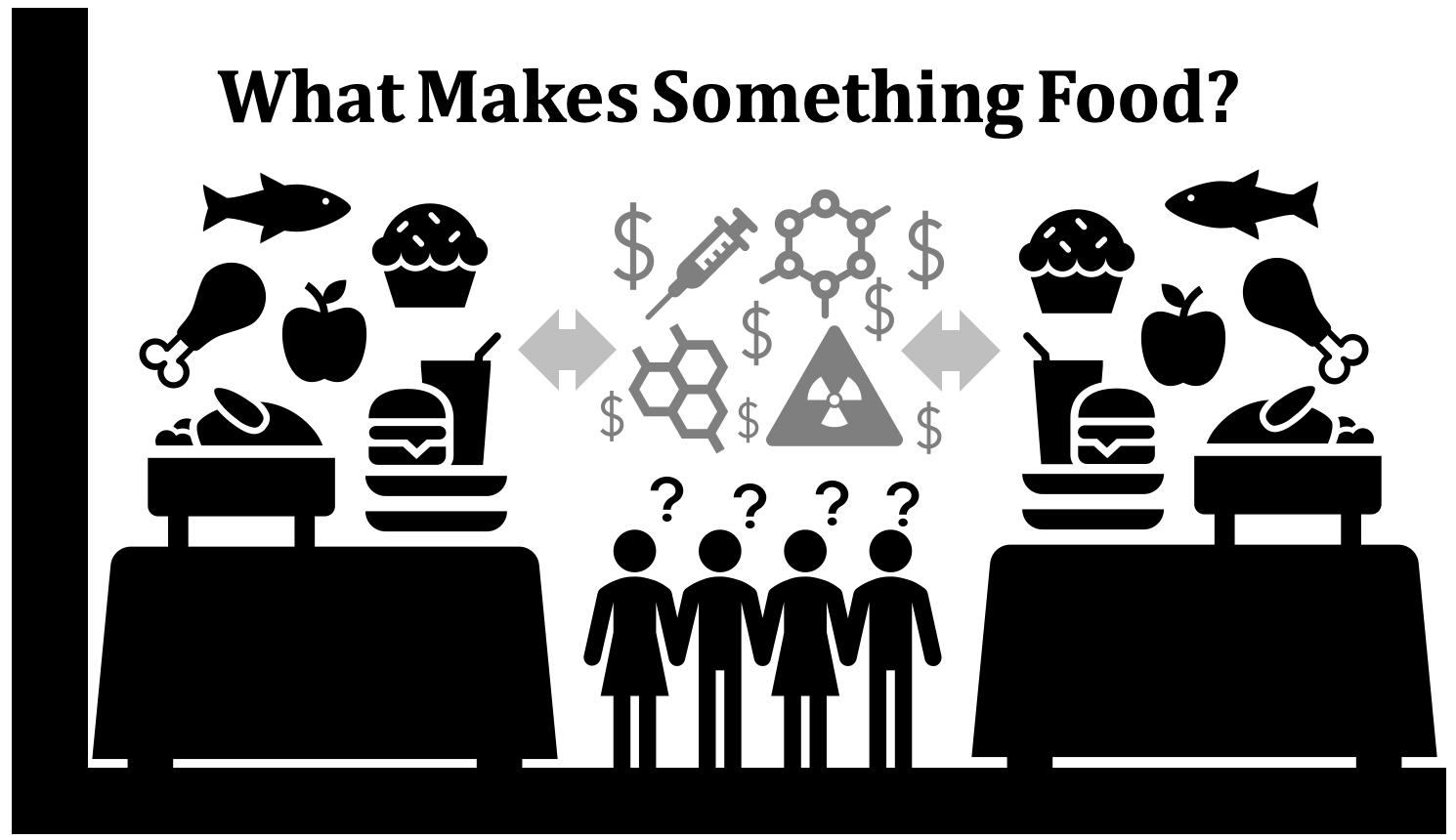
All humans and animals require Food to survive, but what is Food?
More specifically, what makes something Food?
This question was featured in Part I’s Introduction to help us distinguish between “categorical” and “conceptual” thinking.
We eat things because they are Food — not the other way around.
This basic principle is reflected in the timeless warning from new parents to their child: “don’t put that in your mouth!”
We ascribe many different meanings to the physical objects we encounter in our external world, but recognizing Food is among the most ancient and fundamental classifications that humans can make.
It took millennia of survival by trial-and-error before our species understood which plants and animals could safely be eaten as Food in their respective environments.
Nature was not a grocery store.
Our earliest ancestors had no choice but to develop their conceptions of Food from first principles.
Why do we eat it?
What are our goals?
How are these goals best served?
When thinking about Food categorically, however, the quality need not be considered. Food can simply become “the things that people or animals eat.”
While an accurate description of Food, this would be a dangerously misleading definition.
And as with concepts and categories, this is an important distinction to make.
Descriptions are simply accounts of a person, object, or event. They reflect the perspective of the describer and may diverge considerably from other descriptions — even when the exact same thing is being described.
With descriptions, you can include or omit whichever characteristics you choose.
Definitions are different.
They are attempts to state the exact, general meaning of a word, without regard for a specific perspective. A good definition would extract the most broadly accepted meaning from the totality of characteristics.
This is different from describing something, even if the description is accurate.
We eat things because they are Food. But what makes something Food?
How can we define it?
Whether something qualifies as Food should depend on whether it sustains or enhances life.
But our earliest ancestors could not know this in advance.
They had to learn the hard way.
We are the fortunate beneficiaries of our ancestors’ trials and errors.
Just as each plane crash makes future flights safer, it was our ancestors’ “errors” that generated the most useful knowledge with regard to Food — often at the expense of the individual.
Given the risks associated with eating unknown plants and animals, it was better for early humans to copy existing diets rather than experiment for themselves.
This was the original “risk management.”
It’s normal for humans to think of Food as “what people eat” because this is an ancient survival strategy, allowing us to benefit from the risk-taking of others while avoiding the potentially lethal pitfalls of experimentation.
In the business world, this is called a “second mover advantage” — innovation is copied rather than initiated.
But although this may be a relatively safe rule today, we couldn’t set out this way. Someone had to experiment and discover new Foods before their actions could be observed and copied.
Our Food decisions have always been shaped by what we see other people eating, but mimicry cannot inform our conception or definition of Food.
To “eat what others eat” does not capture the full meaning of Food.
Our species’ unique physical capabilities and capacity for planned action causes human mimicry to produce more varied results than animal mimicry.
Narrowly focused on survival, animals might mimic each other for millennia without meaningfully changing the initial behavior or results. The variety of Foods from which they can choose remains essentially unchanged.
But when humans start copying each other, something entirely different happens.
We use our observations of other people’s actions to help us conceive what is possible.
And we don’t stop here.
By remembering further back and thinking further ahead, our minds work to expand our perceived possibilities. And unlike with animals, these new discoveries could be passed down to each successive generation through language, and eventually writing.
This is a major difference between “Animal Time” and “Human Time.”
Modern humans conceive of Food in many different ways relative to animals.
But after millennia of mastering the question of what is possible, our species’ relationship with Food has become so complex that it’s increasingly difficult to know what is best.
To master The Algebra of Life we must learn to recognize and understand these divergent conceptions.