


In the language of Money, a price is the measurable cost of buying something.
It is a certain amount of a specific currency that must be paid to receive the item.
But the word can also be used more generally, to describe what must be given up or endured to obtain a desired result.
Money prices involve finite amounts, while non-Money prices involve subjective experiences that can be neither measured nor observed.
The specific amount gained or lost (the Money price) is different from the human experience of gaining or losing the same amount of Money (non-Money price).
The exact same number of dollars will mean different things to different people, on different occasions and in different places. How gains or losses of Money make us feel (Human Time) cannot be measured in the same way as the gains or losses themselves.
Money is highly emotional for our species — perhaps more than ever.
That Money prices may change, especially in the long-term, is why “medium of exchange” and “store of value” are distinct functions. But they are also closely related because prices are usually stable in the short term.
Any medium of exchange must also function as a store of value — at least for a brief period — otherwise sellers would not accept it. Conversely, any store of value must also — if only indirectly or to some extent — function as a medium of exchange.
Currencies are the most generally accepted mediums of exchange, but anything that can be easily exchanged for currency may also serve this function.
If Money prices could be relied on to stay the same many decades into the future, currencies would perform both functions equally well.
But Money prices change with Time, and often greatly.
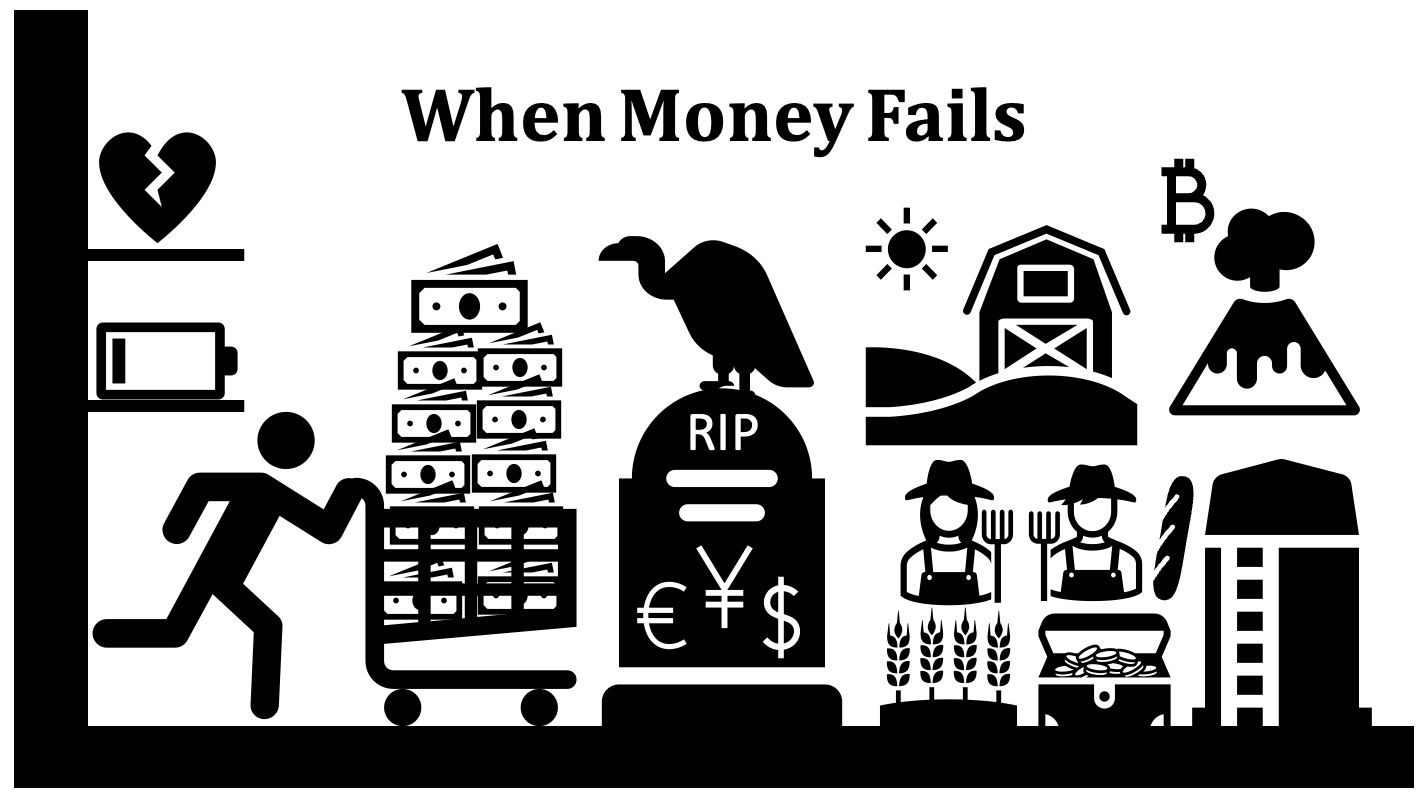
Sometimes, the Money fails altogether.
What could this mean?
In his 1975 book “When Money Dies,” British journalist Adam Fergusson offered a strikingly cautionary account of what happened to Germany’s system of Money after the First World War.
Having borrowed heavily to fund a losing war effort, and then forced to pay steep reparations, the German “central bank” — an institution to be explained later — had little choice but to continuously print paper Money to meet its financial obligations.
This destroyed the value of their currency.
The number of German “marks” in circulation was rising so fast that at its peak, it took only four days for price levels to double. The effects of such large price changes went far beyond the inflation that many nations have experienced since Covid-19.
In similarly affected Austria, Fergusson noted that:
Even the most respectable of Austrian citizens now breaks the law, unless he is prepared to starve for the sake of obeying it.
During periods of “hyperinflation” — prices rising by at least 50% per month — demand for items which facilitate survival rise the fastest. But from the perspective of those selling these items — Food, medicine, and fuel — why accept a failing Money?
Why exchange highly coveted “life-giving” items for pieces of paper that would lose half of their value by the following week?
If a Money cannot be trusted to store value, at all, its use as a medium of exchange will quickly collapse.
As explained in Chapter 2, our bodies require Food throughout our lives regardless of whether we have any Money — and regardless of whether Food producers would even accept our Money.
When prices rise rapidly, this hard biological reality can force people into seemingly absurd transactions. For example, Fergusson recounted the following statements from an affected Austrian woman:
The wife of a doctor whom I know recently exchanged her beautiful piano for a sack of wheat flour. I, too, have exchanged my husband’s gold watch for four sacks of potatoes, which will at all events carry us through the winter.
Food producers and financiers were spared from this economic carnage — some made great fortunes — but large portions of society were wiped out completely. This period of hyperinflation left a legacy of starvation, mass malnutrition, and tuberculosis.
As the availability of Traditional Food staples collapsed, many Germans were forced to adopt cheaper, low-nutrient substitutes. These included natural Foods like turnips, but also Trade Foods like “margarine” — a vegetable fat-based alternative to butter.
Germany was among the most advanced modern societies before the war. It was the industrial powerhouse of Europe, had pioneered social welfare policies, and boasted high literacy rates and a thriving urban middle class.
And yet, after the war, large portions of the German middle class were reduced to lesser nutritional states than even the most impoverished indigenous groups studied by Dr. Price — where Trade Food had fully displaced Traditional Food.
Their Money had failed.
And if a “failed” Money can produce starvation and mass-malnutrition, the deepest meaning of this concept to our species — our intermediation between Time and Food — becomes undeniable.
But this is not a new idea.
And when money failed in the land of Egypt, and in the land of Canaan, all the Egyptians came unto Joseph, and said, Give us bread: for why should we die in thy presence? For the money faileth. (Genesis 47:15)
That a “failed” Money created the need for bread implies that Money was something to be exchanged for Food.
As a political leader, Joseph was overseeing both Egypt’s Money and Food production, which is why the people pled to him. The people were saved — but only after giving up all of their valuable property, land, and agreeing to new taxes.
Though evidently ancient, the close relationship between Money and political authority would persist through modern history and continues to this day.
The next four posts will briefly trace the history of Money through different phases: (1) The “First” Money, (2) Artifact Money, (3) Metallic Money, and (4) Fiat Money.