


Before debts were recorded, they were merely remembered and difficult to enforce.
Remembered debt is less objective than recorded debt, but reliable enforceability is the ultimate source of legitimacy. The previous post’s fictional agreement between Peter and Paul revealed how enforceable debt is a fundamentally different proposition.
Blindly trusting a stranger is different from trusting that the stranger will be punished by a powerful authority if they don’t meet their recorded obligations.
The emergence of enforceable debt records like the cuneiform script was a key milestone in both the history of Money and of our species. Money has become global, but its early development followed different paths in different places.
The story of Money did not unfold the same way everywhere.
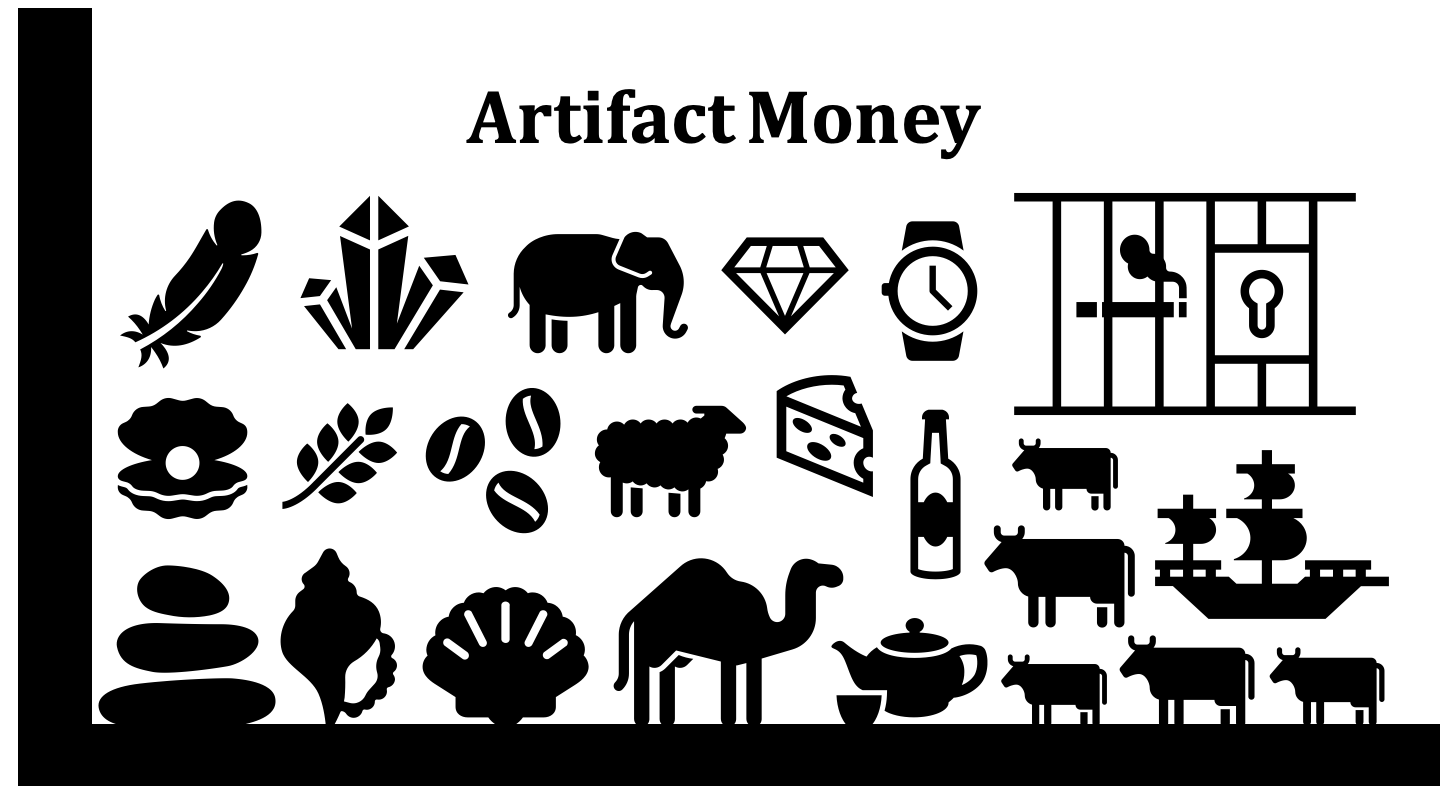
Humans have used many different physical objects as Money throughout our history — sometimes to great advantage or disadvantage.
Before cuneiform script, three-dimensional clay tokens were used as Money in Mesopotamia, but they worked differently from modern currency. Each shape represented a different good that could be received in exchange.
These early forms of “Artifact” Money are less mysterious than the “First” Money, but we can only learn so much from their physical remains. The details are murky.
While Mesopotamian clay tokens represented specific goods, other systems of Artifact Money worked more like modern currency and could be used to purchase anything that was available for sale.
Wherever it first occurred, the shift from single-good to multi-purpose Artifact Money brought the concept closer to our modern understanding. Money was an “intermediary good” — its sole purpose was to be exchanged for other things.
And these “things” were often Time or Food.
But before our modern preoccupation with production and consumption — with making and spending Money — humans first had to decide what to use as Money.
There are three fundamental Money questions:
What to use as Money?
How should you acquire it?
How should you use it?
The first question only seems strange because we’ve been relying on past generations’ answers for so long. And with question (1) seemingly already settled, it became rational to focus exclusively on questions (2) and (3).
Modern humans have done this to great material effect.
But since we never had to face question (1) ourselves, we are no longer familiar with the principles that would be relevant for answering it.
This is why our species’ collective understanding of Money as a human concept is broken.
We seem to have mastered our physical environment, but there are many ancient problems that most modern humans have simply never encountered — important questions have not yet been asked because we haven’t been forced out of necessity.
Chief among these is: “What is Money?” or “What to use as Money?”
Our species has largely forgotten how to even think about these questions, much less get the answers right.
There have been too many different forms of Artifact Money to review them all, but the following example provides an important lesson:
Glass “aggry” beads were used as Money in Western Africa for many centuries. The beads had been handed down from prior generations that had traded with traveling merchants, from whom they were originally acquired.
When contact with these merchants ended, the supply of aggry beads became locally scarce. The lack of local glass-making technology prevented the creation of new beads.
It was on this basis — scarcity — that aggry beads came to be used as Money in Western Africa.
They were the most suitable “intermediary good” for facilitating trade. And since the regional supply of these glass beads had remained stable for many generations, the rates of exchange for different Food products had also remained stable.
The beads represented purchasing power.
They served as a measure of economic output, playing a key role in coordinating the productive activity of the region’s inhabitants. Much effort was exerted obtaining these beads because of the value traditionally accorded to them.
At some quantity — say 500 — members of this culture could comfortably retire from their fields. The beads represented a sufficient “store of value” to purchase the Food they would need for the rest of their lives.
To the West Africans, the stable rates of exchange between the aggry beads and their Traditional Food products were a constant part of life.
These sacred ratios were treated as facts of nature. But the aggry beads’ scarcity was being implicitly taken for granted — this would cost the West Africans dearly.
When European explorers arrived and noticed the unusually high values being accorded to these simple glass beads, they could not believe their luck. Many cattle could be purchased from the West Africans for just a handful.
Recognizing their opportunity, the same Europeans soon returned with an abundance of identical glass beads which they had cheaply produced back home, where glass-making technology was already common.
They bought as much cattle and other physical property as could fit on their ships, before setting sail and returning home.
At first, the West Africans who had received these new beads from the Europeans had considered themselves extremely lucky. They had secured great fortunes — in beads — by selling their physical property to the Europeans.
Many retired early, believing they were set for life.
But those who retained their cattle and continued to produce Food from their land began to notice a problem. They could not possibly produce enough Food to keep up with local demand — at the prevailing prices in beads.
Once the West Africans began to realize that there were now many more beads, but much less Food, prices increased accordingly — and sharply. Those who had sold all of their physical property to the Europeans became severely impoverished.
Their beads could no longer buy the Food they needed. Their Money had failed.
The use of temporarily scarce Artifact Money has led to many such “monetary transitions:” the replacement of one Money system with another. While rare, these events are highly transformative and produce clear economic winners and losers.
To protect themselves against similar injustices, some human cultures had already begun to adopt a form of Money that was far more difficult to cheaply produce.
This was Metallic Money.