


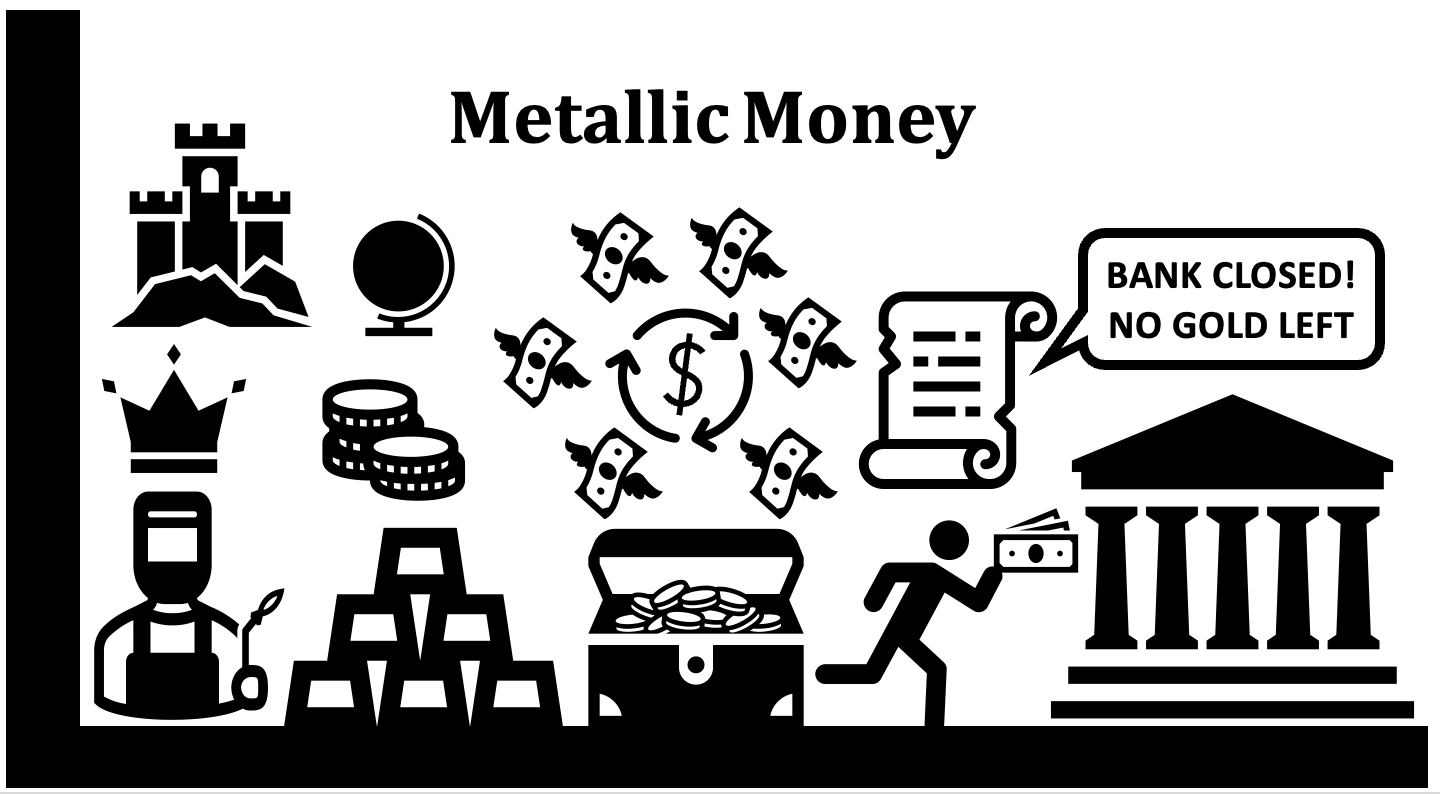
The Olympic Games awards gold, silver, and bronze “medals” to each event’s top three competitors, respectively.
This order happens to correspond with each metal’s value as Money.
Other metals have been used for small denominations, but our species’ principal forms of Metallic Money have been gold and silver.
Unlike aggry beads or other types of Artifact Money, gold or silver cannot be cheaply produced — no matter how advanced the civilization. The use of gold and silver coins with standardized weights facilitated transactions without the use of weighing scales.
Like enforceable debt, a central authority must regulate the “minting” of new coins. But rulers with power over Metallic Money systems are easier incentivized to “debase” the value of their coins by periodically lowering their metal content.
This is what happened in Rome:
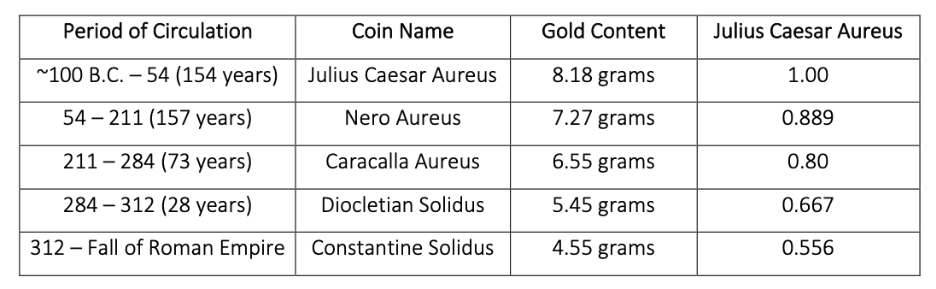
Rome’s silver coin, the “Denarius,” retained only one-twentieth of its silver content.
With a system of standardized coins, the overall supply of Metallic Money is limited by the availability of physical gold and silver. Prices generally remain stable under such a system — but government spending is constrained.
And when nations go to war, this is a problem governments will not bare.
The history of Money has been shaped by the pursuit of war.
The Roman Empire fell because it could no longer fund its defense, and this coincided with the fall of Roman Money. The torch of standardized Metallic Money was carried on by the Islamic world, whose gold “dinar” was introduced around 680 A.D.
The Italian Renaissance and preceding century brought major innovations to Metallic Money via breakthroughs in finance and banking.
The Florentine florin contained approximately 3.5 grams of gold and maintained this standard from 1252 until 1533. How Renaissance banking practices led to our global financial system will be considered in Chapter 5 (Time & Money).
For now, what matters is that Metallic Money began to take a paper form.
Standardized coins were preferable to fragments of precious metal, but paper bank notes offered many advantages over metallic coins — especially when transacting larger sums.
Why use and transport many dense coins if gold could be credibly represented with paper receipts? Physical metals were heavy, costly to store, and risky to transport. Gold-convertible bank notes facilitated more trade by addressing these challenges.
There was just one problem: who should store the gold?
This question has been a major theme of financial history.
After the Renaissance period, financial power shifted from the Italian city-states to the Dutch — where corporations were invented in 1602 — and then to England.
The British Empire combined Italian banking practices with Dutch capital markets to finance their Industrial Revolution, which ultimately powered their global ascent.
The economic engine of the British Empire was sugar, but the financial engine was the Bank of England — that’s who eventually came to store the nation’s gold.
The Bank of England became a state-owned “central bank” in 1946, serving ever since as the United Kingdom’s monetary authority. But it began as a private bank with special legal rights.
This brings us to an important asymmetry within the concept of Money.
For regular people, the prevailing system of Money marks the economic boundaries within which their lives must be conducted. Like gravity or weather, this is a fixed constraint. We may strive to earn more Money but we cannot change the system.
But centers of power may occasionally change the very system of Money to suit their own needs or goals.
In 1694, the Bank of England was created specifically to fund the Royal Navy in support of the King’s ongoing war with France. To induce participation from Money lenders, shares of the Bank were offered which included unprecedented legal rights.
Goldsmiths and private merchants were already issuing paper notes redeemable to gold, but the Bank of England was the first to combine this legal right with the limited liability status of a corporation, which was granted to them by Royal Charter.
This meant that should the Bank of England fail, the investors’ personal fortunes would be safeguarded.
This special status, combined with successive favorable government legislation, enabled the Bank of England to gradually secure a monopoly over the creation of paper Money in England and Wales.
In exchange for funding the King’s war, the Bank of England’s initial shareholders were granted considerable power over the nation’s system of Money.
Roman Emperors had to physically collect the circulating metal coins to debase their Money. But Metallic Money in paper form gave the Bank of England new mechanisms of control, while providing the British Empire with better financing.
For example, gold redemption in England was suspended from 1797 to 1821 to raise war funds. This was only possible because of the deal that had been struck a century earlier with the Money lenders.
The course of our civilization, both domestically and globally, has often been shaped by changes to the Money system.
America’s experience with Metallic Money was similar to the British, but the context of a young, democratic nation made it more turbulent.
History books may suggest that the American Revolution was fought over tea and taxes, but another major catalyst was the British prohibition on the colonial paper Money which the Americans had created for their own use.
Metallic Money was then written into the 1787 Constitution — only gold or silver-based Money could be legal tender.
Early American history saw the formation and dissolution of two central banks, each lasting twenty years, and political battles over “soft” Money — a freer creation of bank notes — and “hard” Money — limiting the supply based on metal reserves.
Lacking a central bank, America entered its “Free Banking” era. And despite victories for “hard” Money at the federal level, state banking regulators didn’t share this philosophy: State banks would not be required to maintain full gold reserves.
This practice, known as “fractional reserve banking,” ultimately caused our species to transition away from Metallic Money towards our current system of Fiat Money.
Many Americans learned hard lessons about “good” and “bad” Money during the Free Banking era, as their savings could disappear if they trusted the wrong bank. The pain wrought by dishonest banking practices culminated with new federal regulations.
Once the political debate over silver’s role as Money was settled in gold’s favor, America followed the rest of the world onto a “gold standard” in 1873.
Forty years later, the creation of America’s third central bank, the Federal Reserve, would sow the seeds of a global transition from Metallic to Fiat Money.