


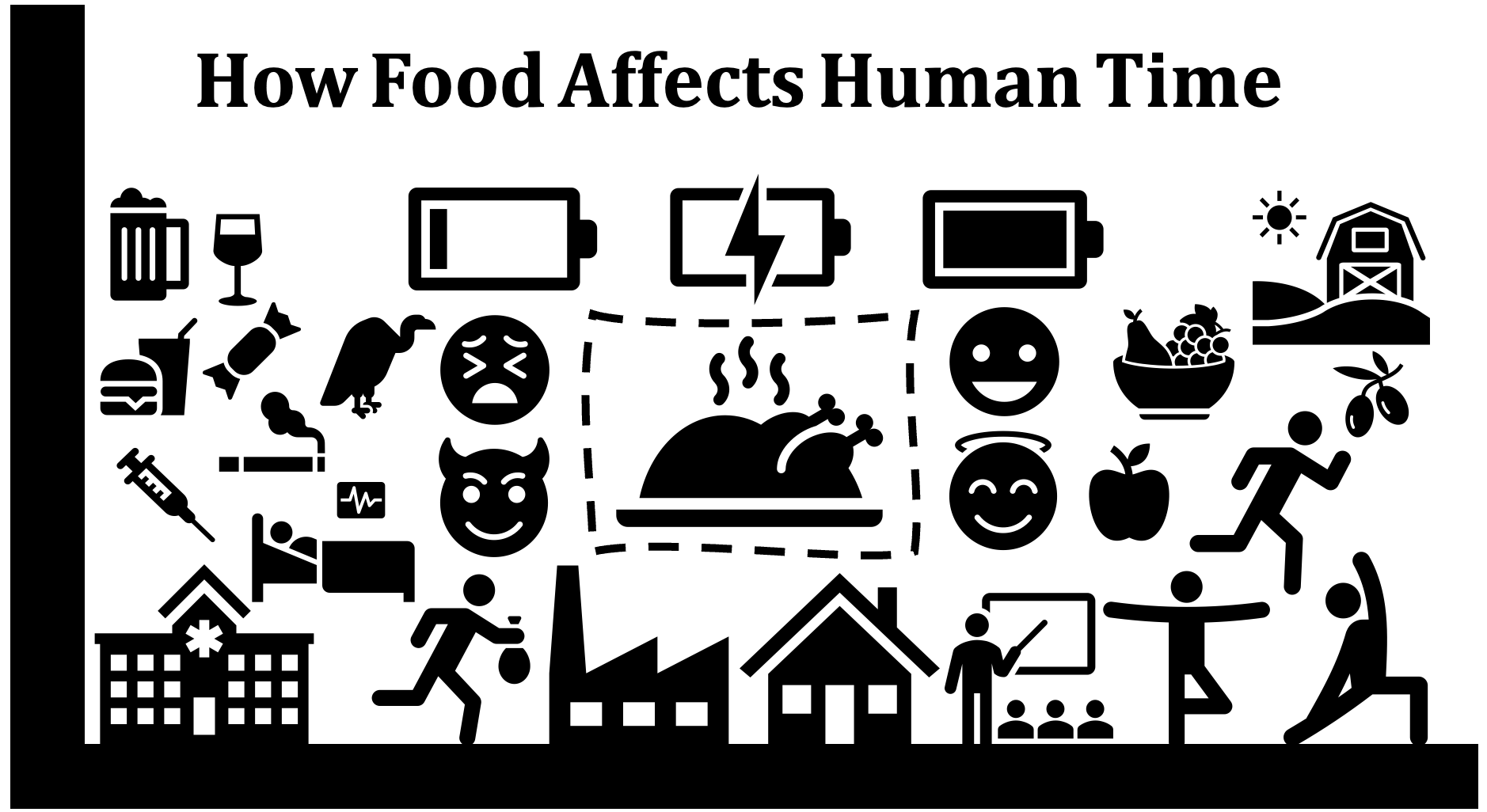
It should come as no surprise that the Foods entering our bodies will affect our experience of Time. Yet, both the strength and breadth of these effects often go unnoticed.
They are most obvious in the short term. The first taste of Food after a long fast may produce a special feeling within us, while modern anesthetics can remove our feelings all together.
Every substance we ingest shapes our lives in big and small ways, in both the short and long term. Through biochemistry, pharmaceutical companies have mapped out many systems of cause and effect within our bodies.
But apart from medicine and drugs, and despite the many modern conceptions of Food, the primary driver of human Food consumption remains the alleviation of hunger.
While survival forms the core of the relationship between Time and Foods, hunger is the negative feedback loop signaling us to eat.
Only a tiny subset of the global population optimizes their Food intake to achieve precise nutritional goals. Most humans consume Food simply to alleviate hunger — to provide short term energy.
Increasingly, this hunger is linked to pleasure or stress relief rather than an actual calorie deficit. Apart from athletes, bodybuilders, and the exceptionally health-conscious, we are mostly concerned with the immediate effects and costs.
This includes the Money price of our Foods — especially as prices rise around the world. The less we spend on Food, the more we have left over for other things.
Ultimately, modern humans select Foods for their taste (Human Time), convenience (Measured Time), and cost (Money). Nutrition is a distant fourth.
The tendency to prioritize immediate results is not limited to our Food choices.
Favoring short-term over long-term outcomes is known as “high Time preference,” and this is our species’ default biological operating system.
The further into the future that the outcomes of our actions will or may occur, the less we care — even when negative results are mathematically certain.
This principle applies to all three domains of decision-making: Time, Food, and Money.
Short-term thinking is everywhere. Common examples from the domains of Time and Money are playing video games instead of completing schoolwork, and taking out loans to make unnecessary retail purchases, respectively.
These are examples of “high” Time preference. In the language of the famous marshmallow experiment, this reflects a lesser ability to delay gratification.
On the other hand — really it is more like one finger out of ten — gratification may be intentionally delayed for the purpose of achieving a more distant goal.
But these are the outliers — the kids who resisted eating the single marshmallow to enjoy two marshmallows later. Careful preparation for examinations or saving and investing extra Money are classic examples “low” Time preference.
In these scenarios, gratification is being delayed intentionally to serve a future goal.
The domains of Time and Money present their own unique risks to those unable to delay gratification, but the domain of Food is treacherously unforgiving and with fewer guardrails — despite the modern emphasis on Food safety.
Mandatory education for children and mandatory retirement plans are institutional guardrails designed to mitigate our species’ innate biological short-sightedness — our “high” Time preference.
Nearly every country enforces compulsory education for their youth. Even for adults, more than thirty countries impose mandatory retirement savings programs, with many others incentivizing such programs through tax benefits and subsidization.
But with Food? There are fewer guardrails and more corporate traps.
Following the United States’ lead, many western governments rolled out similar Food guides (also known as the “Food Pyramid”) which emphasized consuming grains while limiting meat and dairy.
Today, it is widely acknowledged that the United States Department of Agriculture’s 1992 Food Guide Pyramid was designed in collaboration with the grain industry’s powerful representatives — not nutritional scientists working for “the people.”
Public education and government retirement programs have their own weaknesses, but with Food we are truly on our own. Our bodies never stop keeping score. And the more we fall behind, the harder it is to make a comeback.
Both Time and Money may be wasted by short-term thinking, but negative results in these domains are more comprehensible than our bodies’ complex biochemical relationship with Food. Counting calories and weighing ourselves cannot tell the whole story. Too often, we become ticking time-bombs for chronic disease.
Dr. Price’s empirical investigation into the causes of aggressive tooth decay revealed an undeniable connection between the Foods we eat and how we experience Time. He witnessed first hand how the collective health of traditional human cultures quickly degenerated wherever Traditional Food was displaced with Trade Food.
Our early ancestors acquired Food directly, with very different selection criteria. They could not yet explain the underlying biological mechanisms, but this did not matter.
Life giving properties were life giving properties.
For the isolated Swiss villagers, herding their cows to the glaciers edge was practiced not to produce more Food, but to produce better Food. Their “first butter of spring” was highly prized for its special nutrition, signaled by a deep orange color.
How such substances interacted with human bodies was a more important consideration than how easily they could be produced, or how much Money they could be sold for. The value of Foods associated with strong and healthy families was always recognized and safely guarded — Money prices did not apply.
The arduous transport of sea kelp to ward off thyroid disease in the high Andean mountains is another example of a traditional human culture prioritizing life-giving properties over convenience.
Our modern Food supply could not be more different. The “early adopters” of Trade Foods, particularly those from traditional cultures, paid a steep biological price.
Nutritionally, however, early British Factory workers may have fared even worse.
Before the globalization of cheap and convenient tastes with unending novelty, the ascendence of Trade Food was based on the need for low-cost calories to energize a growing population of disenfranchised factory workers.
Cheap Trade Food was a crucial catalyst for the human labor that powered Britain’s industrial revolution. That is what we will explore next.