


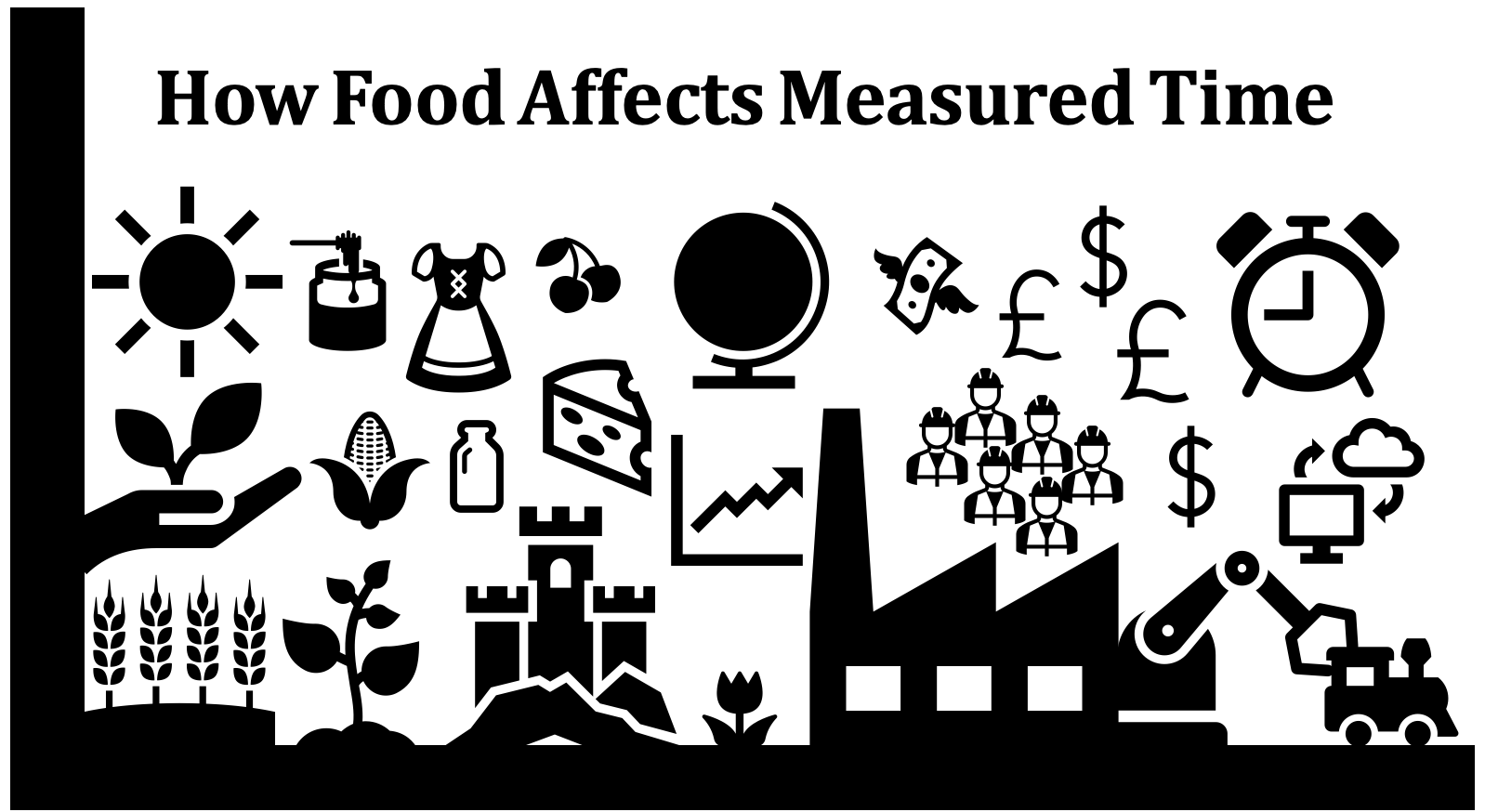
Despite its potential to deeply alter our experience of Human Time, our consumption of Food does not literally affect the passage of Measured Time.
The sun continues to rise and set with its predictable rhythm, and the hands on the clock do not move any faster or slower whether we are hungry or full.
What we are talking about here is how the transition from Traditional Food to Trade Food simultaneously revolutionized our species’ relationship with Measured Time.
As Food increasingly became something to be produced in exchange for Money, we began to structure and understand measured Time in new ways.
With Traditional Food production, Time was kept by the sun, the seasons, and the weather. The nature of labor was task-oriented and flexible — it happened only when there was work to be done and was not rigidly coordinated.
To align with seasonal Food production, our species’ conception of Measured Time had traditionally been cyclical. The passage of Time was thought to be circular.
With Trade Food, Time became linear.
As the global expansion of Trade Food caused weather and seasonality to be overcome by science and technology, modern humans began to conceive the passage of Time as a straight line.
Time no longer “returning to the beginning” but proceeded linearly through entirely new ages. The sun was de-emphasized in favor of clocks and calendars.
Over the last century, as a diverse range of imported Foods became available year-round in many parts of the world, we have departed even further from the circular conception of Time.
But to fully grasp the extent of this change, we must look further back than the Industrial Revolution and post-war ascent of convenience.
We must begin with the origin of coerced (forced) labor and proceed from there.
The emergence and history of coerced labor is a product of the evolution of military technologies, and the accidents of geography.
For most of human history where we lived in small tribes, the group could always band together to kill or exile a tyrannical leader, should their living conditions warrant such an action.
Innovation in methods of inflicting and defending against violence changed this.
Over Time, as these methods became more complex and expensive, distributed violence collapsed into the rise of kingdoms which controlled ever greater lands. With violence monopolized, economic surpluses — both Time and Food — could be ruthlessly extracted and protected.
Unlike most tribal leaders, a king that has monopolized violence will have large numbers of human soldiers and servants who are dedicated to their service, either via promise of reward or threat of punishment.
And unlike the cheaper chemical conveniences of modern mass production, the traditional conveniences enjoyed by kings were extremely labor-intensive. Kingdoms were fed by taxing their Food producing subjects.
Much of the modern convenience industry is meant to mimic, often cheaply, the lifestyle of kings. Freedom from labor is a sign of luxury.
In Ancient Egypt, despite being culturally anchored to a cyclical conception of Time, the massive state could develop as it did because it operated structurally on linear Time. The combination of certain geographic advantages and their perfection of Mesopotamian accounting methods was the basis of their agricultural empire.
Although the Pharaohs collected taxes in grain for the purpose of foreign trade, they did not micromanage production as do modern corporations. Unlike temple building and other public works projects, agricultural production was more decentralized and had relative autonomy — apart from the centralized control of water.
Egyptian priests and peasants retained a cyclical conception of Time, but their rulers were using linear measures and mathematics to exploit natural production cycles.
Nearly two millennia later, Britain’s Industrial Revolution decisively moved virtually all classes of peoples onto the linear conception of Measured Time.
Unlike the State-planned public works projects of Ancient Egypt, where central powers could pool labor through direct compensation or threat of punishment, the situation was different for British private interests during the Industrial Revolution.
Their factories required unskilled labor at the lowest possible cost. Unlike Egyptian temple building, British manufacturing was about pursuing and maximizing profits.
But Britain had evolved politically since the feudal period, where local lords had free reign over their subjects. “Freedom of contract” was the new organizing principle. The exploitation of human labor now required both parties’ voluntary agreement.
This posed a problem for wealthy factory owners.
The amount of Money they were willing to pay was not enough to incentivize giving up peasant life and moving to the city.
The solution was to legally enclose formerly common land, making peasant life as it had existed for many centuries, impossible. With nowhere else to go, masses of peasants fled to London and other major cities where they could sell their Time to factories in exchange for just enough Money to buy the Food required to survive.
The availability of cheap Trade Food — things that factory owners would likely never eat themselves — also helped to facilitate this new economic arrangement. While technically “voluntary” under British law, the British Isles had become a Food desert with industrial cities becoming the new Nile.
There was simply nowhere else to go.
From this point on, our Time was mechanically coordinated with clocks rather than guided by the rising and setting sun. We started to measure our Time by the hour and work week, as well as by how much Money we could receive.
The British Empire quickly spread this mindset to all parts of the world.
The era of Time and Food was being eclipsed by a new age of Time and Money.
This changed how humans spent their Time, while violently restructuring our consciousness.
That is what we will explore next.