


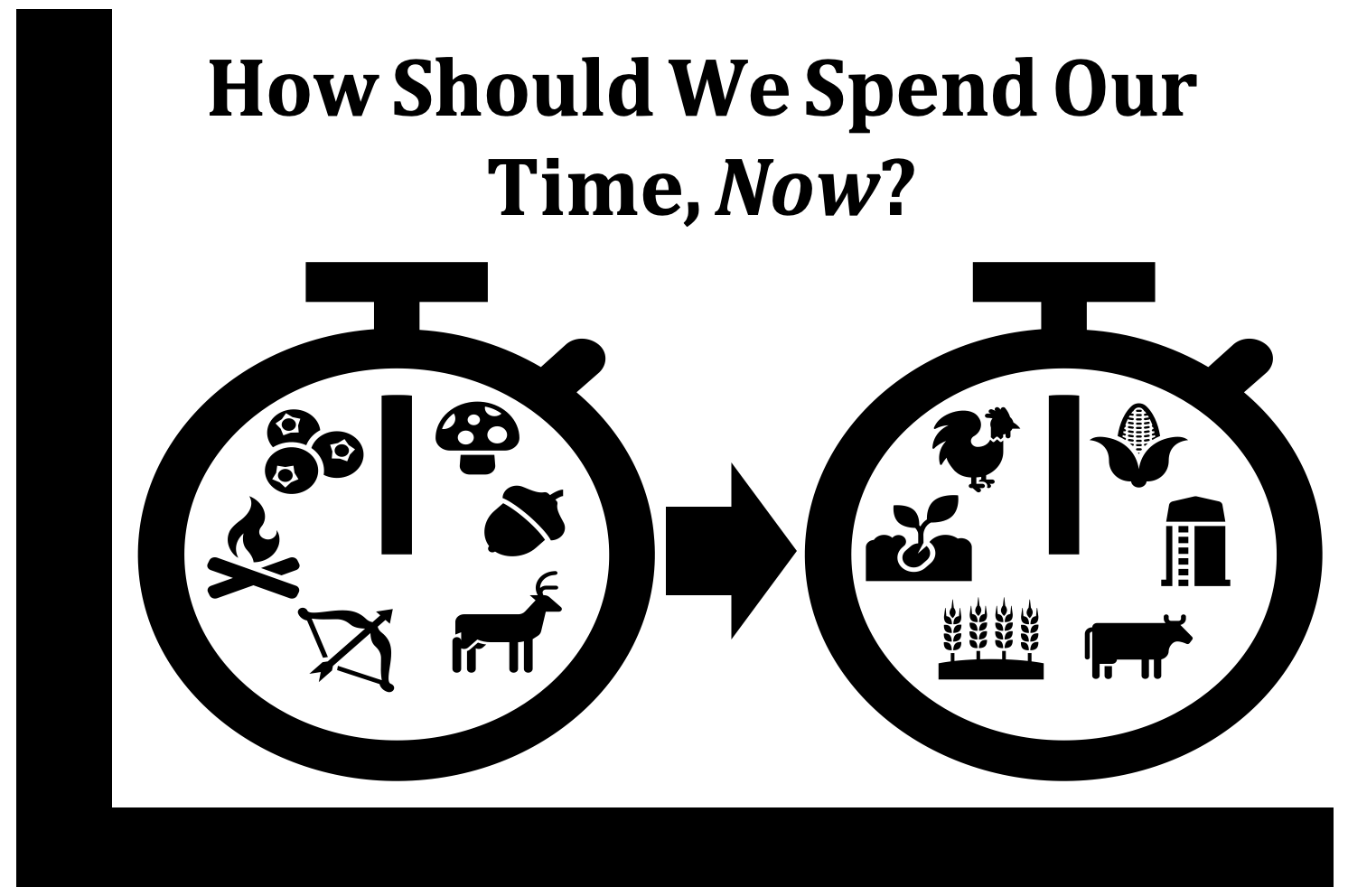
Early hunter-gatherers could use their Time to acquire Food in two ways:
Hunting or gathering.
Ancestral knowledge was not entirely stagnant, but it could only develop incrementally as each generation adapted their inherited Food-finding techniques to the then-present conditions.
With minimal accumulated knowledge, the earliest humans were forced to navigate by “trial-and-error”. Only once we understood what qualified as Food could we begin to refine our methods.
After learning what to eat, our species proceeded to master the issues of when, where, and how to acquire Food.
This knowledge would be passed down to the next generation, who would then adapt and apply it to their own circumstances. These repeated efforts are what gradually formed a shared knowledge base concerning Food, safeguarding the future viability of our species — and serving as our primary protection against famine or disaster.
But as this information accumulated over Time, it became increasingly difficult for individual humans to make new and meaningful contributions. To a “late” hunter-gatherer, the best techniques seemed to have been discovered and refined long ago.
Agriculture changed all of this.
Learning how to farm and raise livestock was a major step-change in our species’ development.
Unlike the deeply entrenched hunting and gathering knowledge, which could be improved only slowly and incrementally, the emergence of agriculture opened a vast, unexplored frontier.
The rules were yet to be written, making anything possible.
We then scattered the globe to find the most suitable land for agriculture, launching an era of experimental farming that took root within the imaginations of our “founding farmers”.
Our species learned to grow and raise region-specific Foods in accordance with local climates, developing highly specialized expertise in the process.
This gave rise to cities.
Agriculture enabled large numbers of humans to live permanently in fixed locations. Hunter-gatherers had traditionally moved with the seasons and built only temporary shelters — but agriculture made permanent settlement advantageous.
Our ability to produce surplus Food dramatically changed what it meant to be human.
We still had to accept what nature offered, but our biological fate was increasingly something that our species could take into its own hands. We could not fully control nature, but we were beginning to harness it to our advantage.
Most farming is rural today, but cities were born out of agriculture.
Cities offered security and facilitated a more efficient production of Food.
As we transitioned from hunter-gatherer to agricultural lifestyles, the simultaneous rise of cities and Food surpluses had profound and lasting effects on our species’ development:
First, it forever altered our politics and social relations.
Leadership was directly observable in nomadic tribes, which promoted accountability. The exercise of power by city rulers is inherently less transparent. The provision of Food still mattered in a city, but stored surpluses removed the immediacy of this concern.
With cities, there was more Time available to plan for and worry about other things.
As secrecy became possible, deception became practical, and human politics became far more exclusive and complex. For the first time, the lifestyles of rulers at the top of human hierarchies began to diverge considerably from those at the bottom.
Second, it reinvigorated our relationship with ideas.
Agriculture freed our species from the shackles of ancestral knowledge, opening our minds to new ideas in general.
If Food could now be willed out of the ground, anything was possible.
The rise of cities caused new information to quickly germinate and spread. There were now both new things to talk about and new people to talk to.
As strangers from distant lands exchanged information, early cities became hotbeds of innovation and melting pots of culture. As the first iteration of a “marketplace of ideas”, these cities were instrumental in shaping the trajectory of human thought and civilization.
As new Foods entered our bodies, new ideas were entering our minds.
Finally, agriculture revolutionized our relationship with Time.
Unlike hunting and gathering, which are oriented more in “the present”, farming and raising livestock require long-term planning as well as careful, consistent cultivation.
Our species’ transition to agriculture caused the future to occupy a growing space within our minds. We began to think ahead, delaying gratification to improve our futures.
Human life gradually became less dominated by immediate Food-finding concerns.
Large-scale production and stored Food surpluses freed up a great deal of Time, which granted some humans the freedom to pursue things like religion, philosophy, science, or art.
These are uniquely human endeavors because animals are too busy surviving.
Next Post: From Imagination & Experimentation to Importation & Exportation
Previous Post: What Makes Us Human and How Has That Changed?