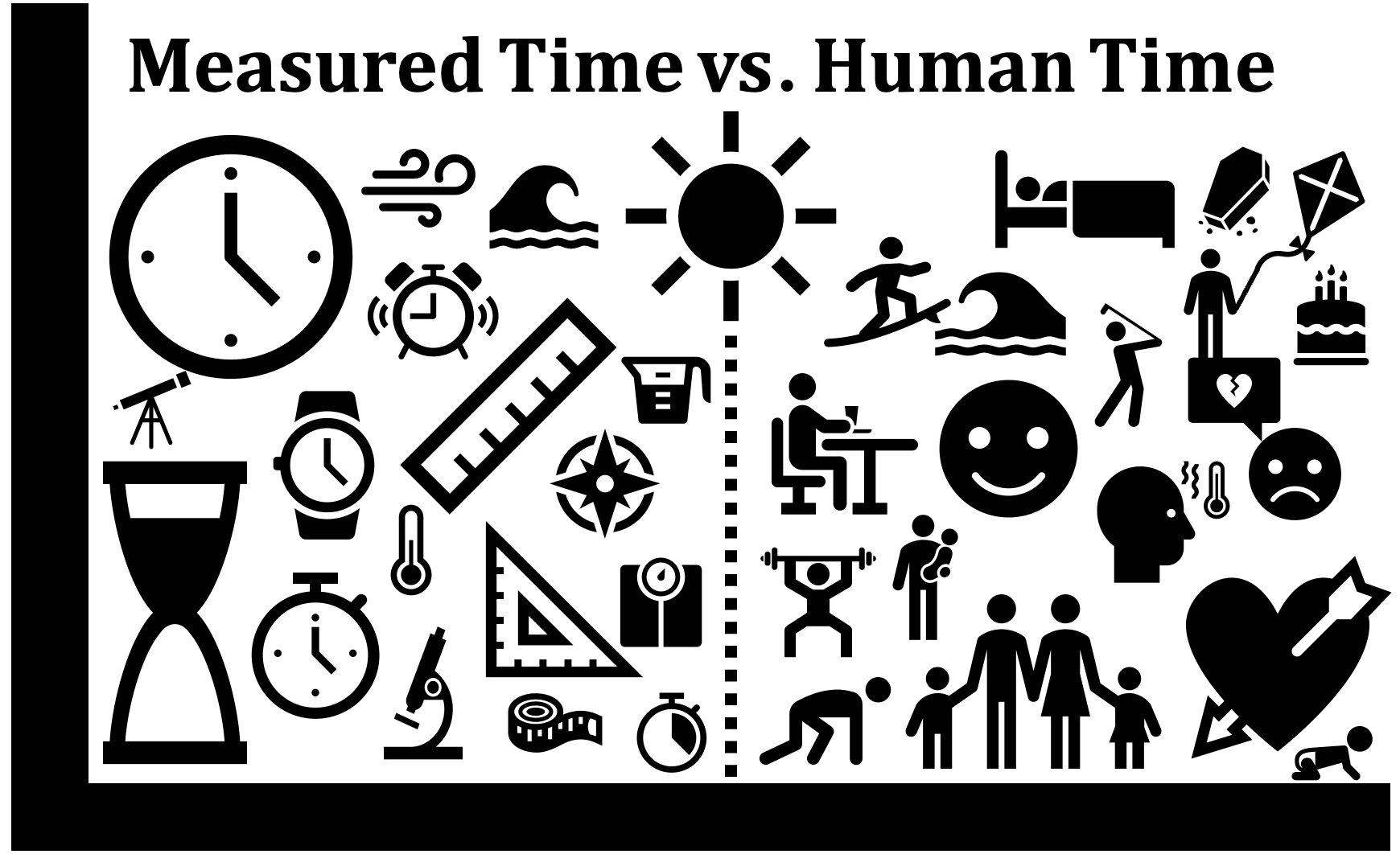
Within The Algebra of Life, the concept of Time is separated into two distinct types: “Measured Time,” and “Human Time.”
Measured Time has to do with clocks and calendars: years, months, weeks, days, hours, minutes, and seconds.
Human Time relates to personal experience. Its duration may be measured, but how we experience Time cannot. We may spend our Time with others, but we experience Time individually, within ourselves.
Our species invented Measured Time by creatively applying their Human Time to the problem of precisely dividing the passing of days. We invented clocks for this purpose, but their output is really just a reference to our changing position relative to the sun.
In some parts of the world, humans adjust their clocks twice a year to better align their waking hours with the Earth’s rotations (daylight saving). This inconvenience does not apply to animals, for whom direct exposure to the rising and setting sun is sufficient to order their lives.
Measured Time is a human concept, but Human Time is more than this.
It represents our experience of life itself.
Humans have invented countless techniques to measure Time with extreme precision, but these scientific endeavors do not help us manage or enjoy our Time any better.
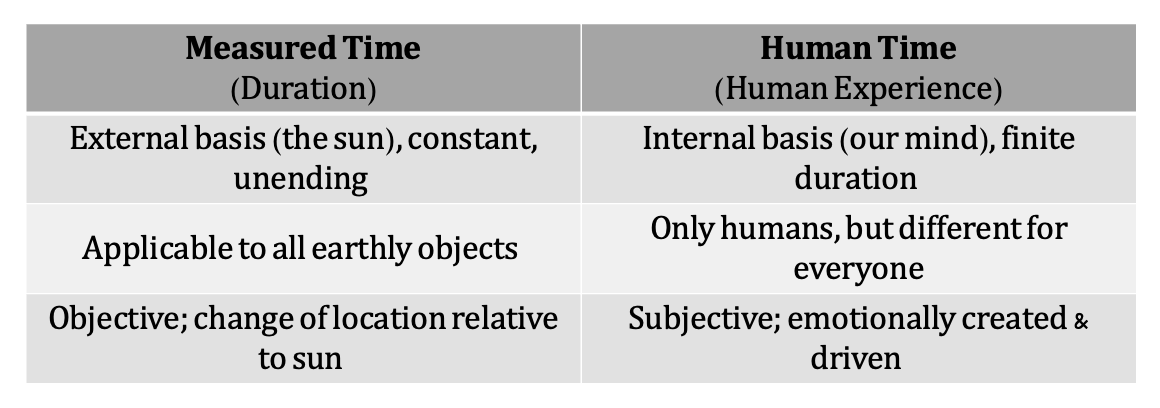
Apart from duration, Measured Time and Human Time are wholly independent concepts with very different characteristics.
Measured Time is universal (at least within our universe), non-physical (you can’t touch it), unending, and can be applied to all physical things.
Human Time is personal.
Its duration may be measured, but Human Time captures what we feel.
It’s our qualitative experience of life itself, which is only felt individually.
Pleasure, pain, happiness, sadness, regret, satisfaction, fulfillment, sorrow, love, hate, anger, laughter, hunger, boredom — and many other states, emotions or sensations — are why Human Time is so difficult to quantify.
The duration of these feelings can say nothing of their content or depth. It would be like judging a book by its number of pages.
Human Time doesn’t come from the sun, but from our minds.
Brains exist physically as organs of soft nervous tissue within the skull of vertebrates, functioning as the coordinating center of cognition and sensation.
Minds, however, do not exist physically.
And yet, our minds are what enable our species to become aware of the external world and our experiences, to think, and to feel.
Our minds are the source of human consciousness and thought. All humans have both a brain and a mind, but only our brains can be observed. No two human brains are identical, but many general traits are shared.
Human minds are more like “black boxes” unto each individual, producing an output that can only be experienced by its owner. As a product of our lived experiences, each human mind is unique.
Although Human Time must begin and end for everyone, it’s experienced differently by each person. Just as our inner worlds cannot meaningfully alter the planetary rotations upon which Measured Time is based, Measured Time cannot see the inside of our “black box” minds.
But Measured Time may affect our experience of Human Time.
If we’re running late for an important meeting, we might experience an increased heart rate, begin to sweat, and will usually alter our behavior accordingly.
The concept of Human Time includes how we feel, think, and act.
Only our actions are observable to other humans, but gaining awareness may change our experience, which can cause us to change our actions.
For example, we might have been lost in thought or conversation before our glance at the clock spurred us into action. As we scramble to avoid being late, what was formerly a relaxed state has suddenly turned frantic, as we become all too aware of the Measured Time.
It may feel like Time is moving faster, but only Human Time can “speed up.”
The response of our nervous system to this situation, and the sensations it produces, are completely unrelated to the speed of planetary rotations around the sun.
This effect can also go the other way.
If we are looking forward to some future event, Time may feel slower. For a student in a classroom on a Friday afternoon who is looking forward to the weekend, their glance at a clock may produce an entirely different internal response.
The Measured Time is now earlier than they had expected (or hoped).
Time is not passing fast enough, nor is it “standing still.” It seems to be “crawling.” We are, once again, all too aware of the Measured Time. Only now we wish it would “speed up.”
How “fast” or “slow” we experience Human Time is closely related to how focused or interested we are in whatever we’re doing.
Time may “speed up” as we rush to our meeting, “slow down” once we’ve arrived, and then begin to “crawl” once we become bored. Everyone experiences Human Time differently.
Part II’s exploration of the interrelations between life’s three variables will consider both Measured Time and Human Time. Their main features can be summarized as follows: