


Chapter 1: Time
“The measured or measurable period during which an action, process, or condition exists or continues”
“A non-spatial continuum that is measured in terms of events which succeed one another from past through present to future”
“A person’s experience during a specified period or on a particular occasion”
“A moment, hour, day, or year as indicated by a clock or calendar”
“One of a series of recurring instances or repeated actions”
“The hours or days required to be occupied by one’s work”
- Selected definitions
“Time” is one of the most common words in the English language.
It can be used as a noun (to identify persons, places, things, or concepts), as a verb (to describe an action, state, or appearance), or as an adjective (to describe or modify nouns).
“What time is it?,” “Can you time my lap around the track?,” and “He arrived on time” are examples of each use.
We can also have good Times or bad Times.
The word serves many functions, but these meanings are ultimately rooted in the idea of Time as a concept. As the selected definitions suggest, this meaning is multi-faceted.
Time can be as simple as a clock or as complicated as our most profound experiences. In this mysterious domain of human life, specialists can offer minimal assistance.
“Time” is not something you can “go to school for.”
Academic philosophers may write about the “meaning” of Time, only to conclude that humans ultimately know nothing.
On the other hand, physicists are more objectively extreme. They conceive of Time in the language of math and physics, only to discover that it doesn’t really exist. Their equations suggest that life is meaningless, and that “free will” is illusory.
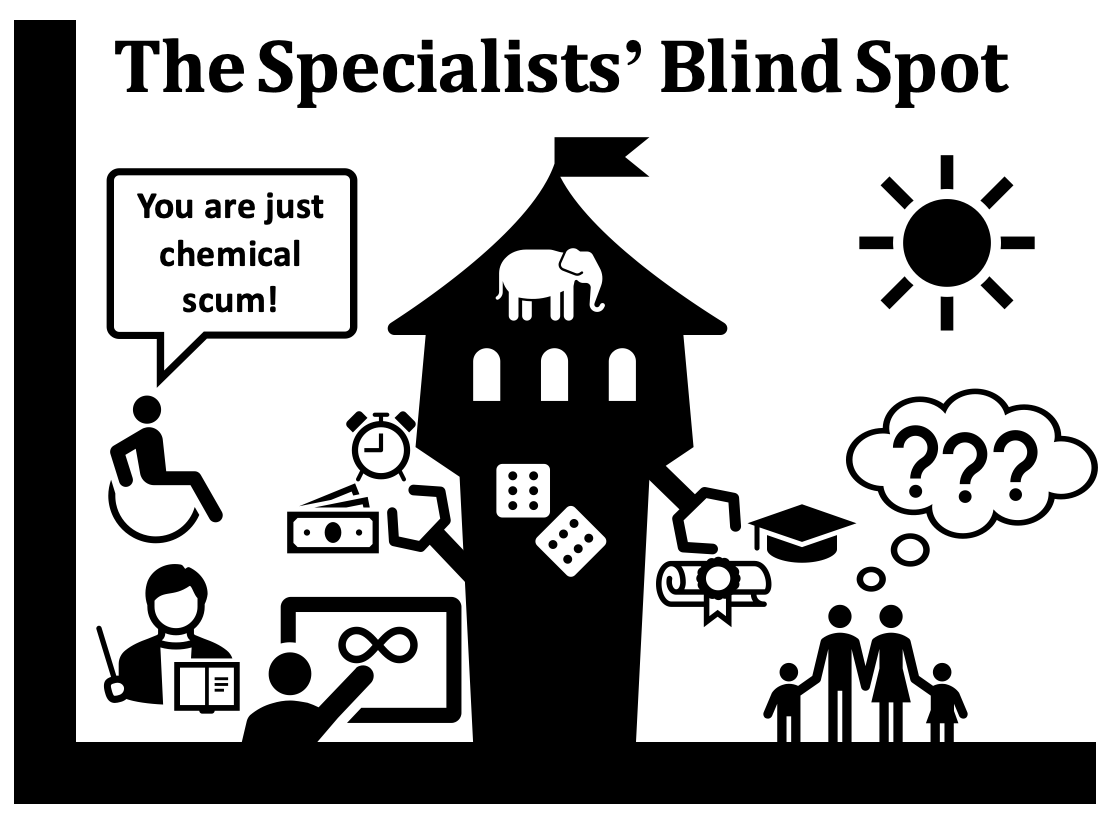
One famous physicist has even described our species as “just a chemical scum on a moderate sized planet.”
But professional academics are, unfortunately, no longer well positioned to create new information that would be useful to regular people. With few exceptions, tenured professors at modern universities generally prioritize their own careers.
This is a very different goal.
At the end of the day, these professionals are exchanging their Time for Money.
But modern academics have long departed from the traditions of ancient Greece, where leading public intellectuals were known to apply their knowledge to the practical matters of daily life.
Today, the pursuit of status and credentials seems to have displaced curiosity and truth-seeking as the basis of most academic effort — and not just among the students, but their teachers as well.
Most modern university professors are neither capable nor incentivized to generate practical insights for regular people.
They would not receive any more Money for their Time.
Professional academics work primarily to impress only their peers, or perhaps the large corporations who may be funding their research. But creating “trade secrets” that can be owned and used by corporations to make Money is different from making contributions of knowledge to human civilization.
And our modern world — especially when it comes to Food — is heavily tilted towards promoting the former.
By writing about narrow topics in arcane ways, and with “peer review” as the only quality control, professional academics generally operate within their own exclusive communities. But these “ivory towers” are lined with mirrors rather than windows, and the few who make it inside can rarely see over the top.
The situation is not so different from the ancient walled kingdoms, whose military dominance over the rural peasantry exempted them from having to use their own Time to produce their own Food.
The cultural dominance of modern universities has, in many cases, caused them to become detached from the “real-world” which the rest of us live in. The modern academic is physically provided for by those on the outside, but what do we get in return? Shouldn’t our lives have become easier by now?
Our institutions of higher learning have largely abandoned the process by which humans have obtained new and useful information throughout our species’ history: real-world experience. When it comes to the concept of Time, the message of academic philosophers and physicists amounts to this:
We cannot know anything. And even if we could, we cannot decide anything.
But the pessimism of these specialists merely reflects the mysterious, interdisciplinary nature of Time.
Using a single lens from a specialized field will not produce a clear picture.
To broaden our understanding of Time, the most fundamental “variable” within the “algebra” of human life, dictionaries are only the starting point.