


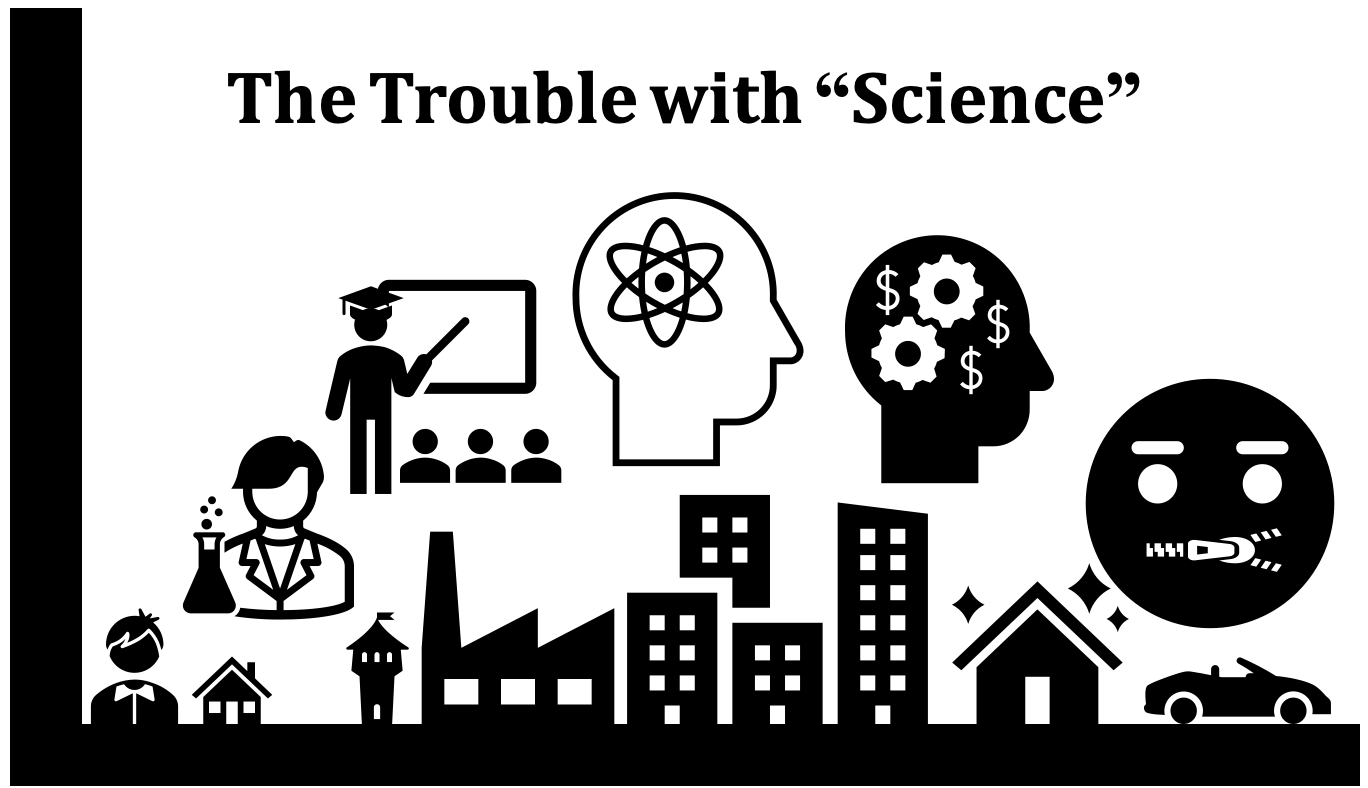
So far, we have divided the concept of Time into two types — Measured Time and Human Time — and briefly described their treatment by several academic fields.
Physics and economics relate more to Measured Time, while philosophy and sociology relate more to Human Time.
Modern economics has mimicked physics’ emphasis on objectivity and precision, while sociology has followed the philosophical tradition of exploring subjective experience.
But economics can never be as objective as physics because dollars are different in nature from minutes, hours, or kilograms. The same Money can be worth different things to different people, in different circumstances.
Using Money to measure value is different from measuring Time, mass, or distance.
Physics and chemistry are understood as “hard” sciences: branches of knowledge where facts and theories can be precisely and definitively tested — and proved.
Economics does not fit into this category for several reasons.
First, the complexity of our behavior (Human Time) makes it impossible to conduct conclusive, lab-controlled experiments on large populations.
Second, the fundamental difference between monetary value and physical mass — one being a variable, the other a constant — makes economic measurement inherently indeterminate.
If the number of centimeters contained within a meter were constantly in flux, or if the ability of steel beams to bear their loads “crashed” every four years, then all modern construction would be futile
And yet, during the mid-twentieth century after the first nuclear proliferation, many prominent economists became afflicted with “physics envy.”
Using numbers and equations gives economics the appearance of a “hard” science, where facts and theories can be definitively tested — but this is only an illusion.
Economic calculations may be useful in the near term, but economists will never be able to make accurate predictions about human behavior in the same way that physicists can predict the movement and interactions between particles.
Neither can sociologists, but they don’t usually claim to. Sociology is, by its nature, a social or “soft” science.
This means that humans are involved.
Labeling “hard” sciences like physics or chemistry as “physical” or “natural” sciences can be misleading, because humans are also physical and natural.
We just happen to also be social.
The core difference between “physical” and “social” science is the involvement of humans and our behavior. Once our species’ incomparably wide scopes for planned action are added to the mix, everything changes.
With so-called “physical” sciences, behaviorally “simple” entities like atoms and molecules are studied, and their interactions can be modeled with great precision. Causation can be binary: theories may be definitively tested (transformed into either fact or fiction) by having “peers” attempt to replicate the study.
This is how scientific knowledge in fields like physics and chemistry has traditionally been created.
The “social” sciences aim to understand far more complex behaviors. While atoms and molecules rigidly adhere to our known laws of physics, the behavior of humans, particularly when in large groups, is inherently unpredictable.
Since our behavior is so difficult to analyze in a controlled manner, the “physical” and “social” sciences have drifted apart.
Taken together, the problems of observability and measurement mean that causation within the social sciences can never be conclusive. Theories from social science cannot be definitively separated into fact or fiction.
The economist cannot test their ideas in the same way as the physicist or the chemist.
This critical difference makes each “science” amount to a fundamentally different activity: the physical sciences use testable theories to produce verifiable facts, while the social sciences use verifiable facts to produce untestable theories.
These are essentially opposite processes, and yet we label both as “science.”
Most people know what science means generally, but even scientists cannot agree on the details.
“Science” is often defined as a systematized body of knowledge that is organized in the form of testable explanations and predictions. But dictionaries remain silent on how testable or how accurate the predictions must be.
To see why this is a problem, consider the following:
Imagine applying “science” to the task of understanding which variables determine an Olympic gold-medal performance in speed skating, and figure skating, respectively.
Both competitions involve “skating,” but the testability and accuracy of our explanations will diverge considerably.
With speed skating, a single physically measurable variable — speed — offers both a good explanation and predictive certainty, assuming the rules of the competition are followed. The fastest speed skater will win the gold medal.
Figure skating is not so simple.
To determine the winner, a panel of human judges must consider various criteria associated with the performance. The variable of “falling” may help us to rule out competitors, but differentiating among the best performances is a more complex task.
And this complexity is the perfect cover for human figure skating judges to accept Money bribes from other interested parties in exchange for altering their scoring.
With figure skating, external variables may play a hidden role.
But speed skating outcomes are more difficult to influence with Money.
The point isn’t that one type of “science” (or ice skating) is superior to the other, but to show how fundamentally different they are when it comes to making testable and accurate predictions.
This matters because we’re regularly encouraged to follow “the science” but our sciences often don’t follow each other.
With “hard” science (speed skating), results are so apparent that they cannot be sensibly argued about.
But with “soft” science (figure skating), reasonable people can disagree — or be paid Money to pretend that they disagree, and with plausible deniability due to problems of measurement or observability.
It’s not “science” that humans should follow, but knowledge derived from testable explanations, particularly those that can be used to make accurate predictions.
We are a complex species, and this has caused trouble for science.
The “physical” and “social” sciences are better framed as “simple” and “complex,” with the involvement of Human Time and as the dividing line.
Next, we’ll learn to better appreciate the deeply mysterious nature of this concept.