


Scientists can hardly agree that consciousness exists, much less understand it.
Serious discussion of the topic seems to be reserved for specialists — although this has been changing in recent decades.
The future is uncertain. Even the past is uncertain, to our minds.
We’ve previously described the past and future as being separated by the present, but this doesn’t prevent our memories from interacting with our hopes, dreams, fears, or expectations.
The boundaries between these cognitive layers are porous.
Our present is chaotic.
We may have negative experiences which “scar” us, leaving lasting memories which dampen our hopes or dreams in some way.
On the other hand, positive experiences may enhance our conceptions of what is possible or which is best.
Our past and our future only exist within our minds, where they can’t help but interact with each other.
Consciousness may come from the interactions between our “past” and our “future” — the interplay between our memories and expectations. But since neither can be measured or observed, the interactions between them are even harder to analyze.
That our consciousness may be a synthesis of our perceptions of the past and future is an untestable theory, but it’s a sufficient approximation for our purposes.
Learning to use consciousness to our advantage is more important than being able to precisely define it.
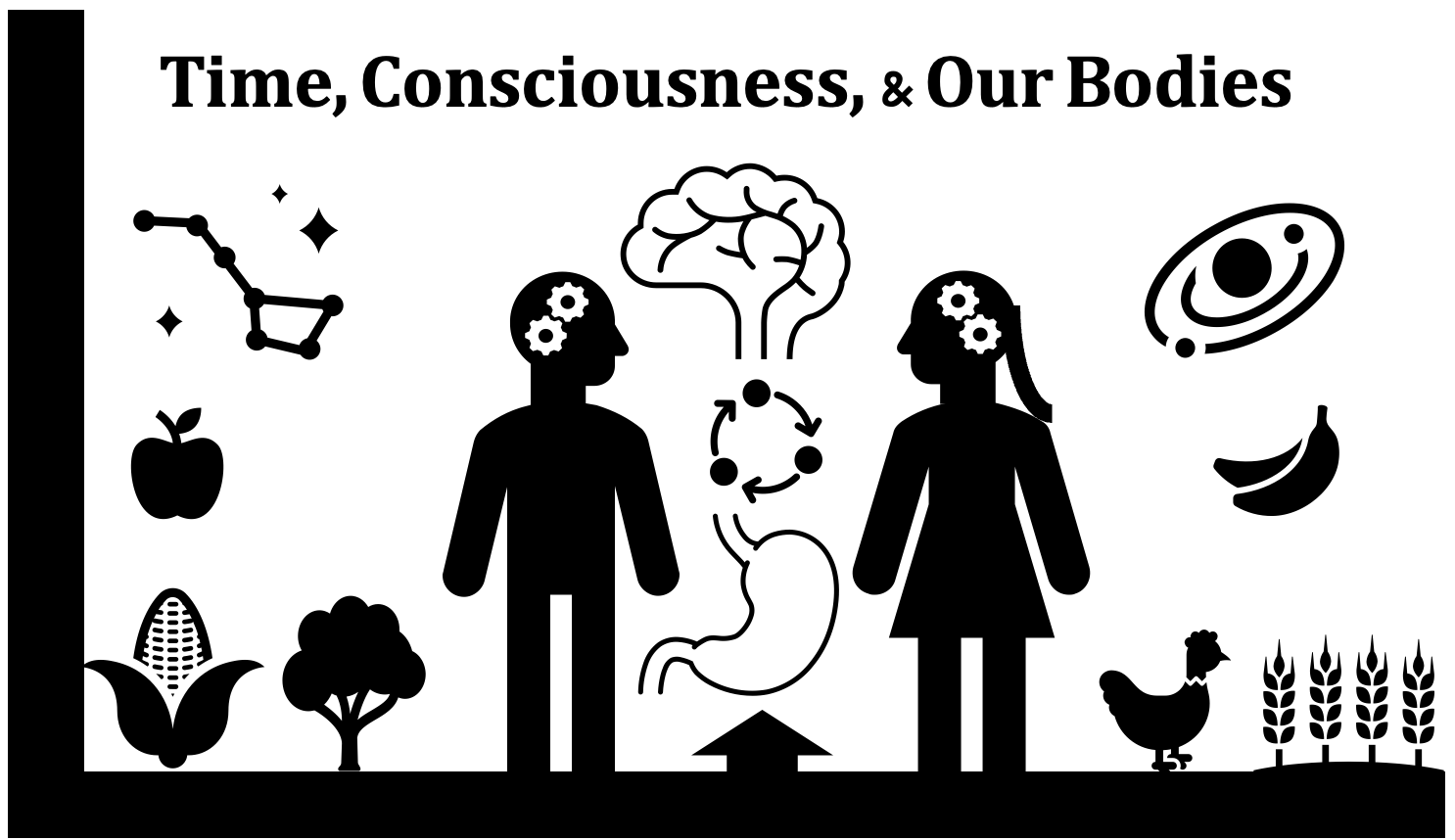
Although it originates within our minds and cannot be directly observed, our consciousness serves as a vital link between our species’ experience of Time and our physical bodies — particularly with regards to Food.
Unlike our thoughts or feelings, our bodies must adhere to the laws of physics while also complying with the natural rules of many other chemical and biological systems.
Chemistry is the science of matter, while biology is the science of life.
Physics is about energy and force.
All of these apply to both humans and animals.
Our chemical Foods interact with our biological bodies. But since humans consume a much wider variety of increasingly complex Foods relative to animals, our bodies’ interactions with these Foods is also more complex.
As a species, we can physically access virtually any Food that can be found in nature.
We’ve invented a seemingly infinite number of synthetic “Food products.”
And the medical, dental, and pharmaceutical industries have introduced many of their own non-Food chemicals to our bodies over the years.
Remember: within The Algebra of Life, the domain of Food includes everything that goes inside our bodies — not just what we typically think of as “Food.”
Animals certainly feel how Food affects their bodies, but only humans can become consciously aware of the biochemical mechanisms through which their Food interacts with their internal systems.
Modern humans are uniquely capable of becoming aware not only of how certain Foods makes their bodies feel, but also why.
If you pay attention to your body, you can feel what you eat.
And if you pay attention to the underlying science, you may begin to understand why. But it can also be a rabbit hole. Not everything is settled.
Eating or drinking too much will produce certain feelings in the short-term, but there are also longer-term considerations: the next morning, month, year, or decade.
We also don’t want to run out of Money — but that’s a topic for later.
The relationship between the Foods we eat and our experience of Human Time will be returned to in Chapter 4 (Time & Food). For now, know that it exists.
By synthesizing our brain’s perception of our bodily states, consciousness is what connects our experience of Time to our physical bodies.
But before the more complex relationships between Time and Food can be analyzed, we must first introduce the second “variable” of The Algebra of Life.
What is Food?
How should we think about Food?
These questions will be addressed in the next Chapter.