


Eating to have good health is different from eating to survive.
As modern humans, we want to thrive.
This means avoiding illness or disease in the short, medium, and long-term.
During the 1930s, a Cleveland-based dentist embarked on an epic research adventure to better understand the cause of rampant tooth decay among his urban patients.
His findings are highly instructive.
Having immigrated from Canada to begin practicing dentistry in Cleveland, Ohio, in 1893, Dr. Weston A. Price (1870 — 1948) believed himself to be living in the beacon of human civilization.
This is why, over the ensuing decades, he became so alarmed.
This was not mild tooth decay.
He was encountering systemic bacterial infection of oral tissues, causing persistent mouth ulcers and swollen lymph nodes, often resulting in tuberculosis — a highly fatal disease if untreated, still responsible for over one million deaths annually.
Although his patients’ proximity to modern treatments meant their lives were not likely at risk, Dr. Price remained both shaken and intrigued by the rising prevalence of such severe tooth decay. He couldn’t help but wonder:
What could be causing such rampant chronic disease in a modern American city?
He spent the next decade searching for an answer.
To investigate the cause of dental deformities, Dr. Price visited a variety of distinct indigenous groups living in near-isolation from the industrial world — tooth decay was almost non-existent. So he set out to study their diets and health outcomes.
Some of these groups were very different from each other.
In North America, he visited the Arctic Inuit, the Dene and Cree tribes of Western and Central Canada, respectively, and the Seminole Indians of the Florida everglades.
In South America, he visited indigenous groups in both the Peruvian Highlands and the Amazon Jungle.
In Europe, he visited isolated Swiss villagers, as well as the Gaelic communities off the coast of Scotland who lived on the fringes of industrialized civilization.
In Africa, he visited cattle-keeping pastoral tribes (e.g., the Masai), agricultural tribes (e.g., the Kikuyu), the hunter-gatherer Pygmies, as well as groups inhabiting the Nile River Basin (e.g., the Dinka).
In Oceania, he visited the Australian Aborigines, the Māori of New Zealand, and several different groups of indigenous Pacific Islanders.
Within each of these groups, there were both members who had remained isolated, living in accordance with ancestral tradition, and members who had left their groups to live and work in modern settlements, only returning home periodically.
These were ideal conditions for a comparative study.
Port cities and mining towns were common destinations for indigenous youth and their families, but living here required adopting a very different type of diet.
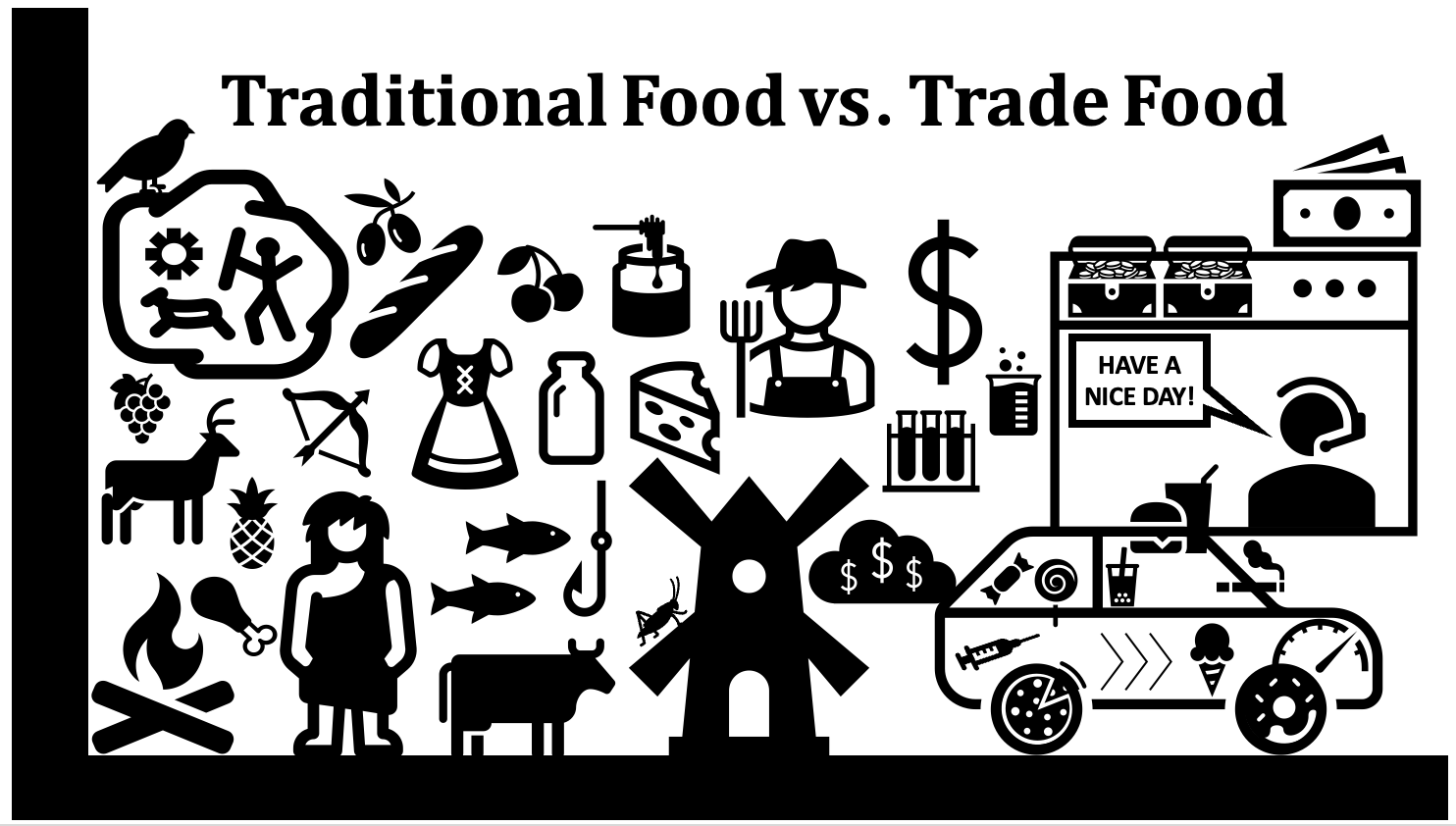
For the most part, the only Foods that were available — or that could be afforded — were the colonists’ Trade Foods: items that could be preserved for an overseas journey.
Across all the groups visited by Dr. Price, the Trade Foods relied on by those living away from their traditional communities were largely the same: white flour, refined sugar, polished rice, vegetable fats, and canned goods.
Despite little access to modern medicine, every traditional culture had exhibited near total immunity to dental deformity — until Trade Food was introduced.
From the Arctic to the Amazon, the local geographies and ecosystems of these groups varied considerably. They learned to adapt.
The Inuit, living in frozen conditions, relied exclusively on animals — caribou, wild fish, and especially seal and whale fat. The groups living in Canadian forests also relied on local animals, with a great emphasis on organ meat.
Moving south, the Seminole Indians hunted deer and wild birds, as well as turtles and alligators.
In addition to their dried guinea pig, llama, and wild alpaca, the Peruvian Highlands Indians planted many different types of potatoes, corn, and quinoa. Inhabitants of the Amazon Jungle ate birds, river fish, reptile eggs, and native crops like yuca (cassava).
The isolated Swiss villagers relied on high-fat dairy, whole-rye bread, bone broth, and limited summer vegetables. The coastal Gaelic communities utilized seafoods like shellfish and cod livers, along with their traditional oat products.
In Africa, pastoral tribes like the Masai relied exclusively on animals, emphasizing raw milk, high-fat cuts of meat, and even fresh blood.
Agricultural tribes planted sweet potatoes, corn, millet, and beans, supplementing their diets with smaller animals and insects.
The hunter-gatherer Pygmies lived nomadically, hunting wild jungle animals and foraging snails, insects, wild honey, fruits, and edible roots.
Nile River Basin inhabitants followed a hybrid diet consisting of fish, water plants, seeds, and milk from their herds.
The Australian Aborigines consumed a variety of plants and land animals including kangaroo, while the Māori of New Zealand supplemented their seafood-heavy diets with crops like taro and sweet potato.
The Torres Strait islanders relied exclusively on seafoods, while the South Sea islanders supplemented their seafood-rich diets with taro, sweet potatoes, coconut, and the occasional wild pig.
Without exception, these groups’ Traditional Foods included nutrient-dense animal fats and natural whole Foods — while containing zero refined sugar or white flour.
In all cases, whenever Traditional Food was displaced by Trade Food, the local indigenous populations rapidly lost their immunity to the aggressive tooth decay that Dr. Price had set out to investigate.
Their health declined rapidly.
These findings revealed the blunt, biological reality of the global dietary shift that followed the Second Agricultural Revolution: the displacement of traditional, locally sourced natural Foods with the production of complex, globally sourced Food products.
The former is acquired from nature to be eaten (to extend and enhance our Time).
The latter is produced to be exchanged (for Money).
This distinction between Traditional Food and Trade Food is fundamental to The Algebra of Life.