


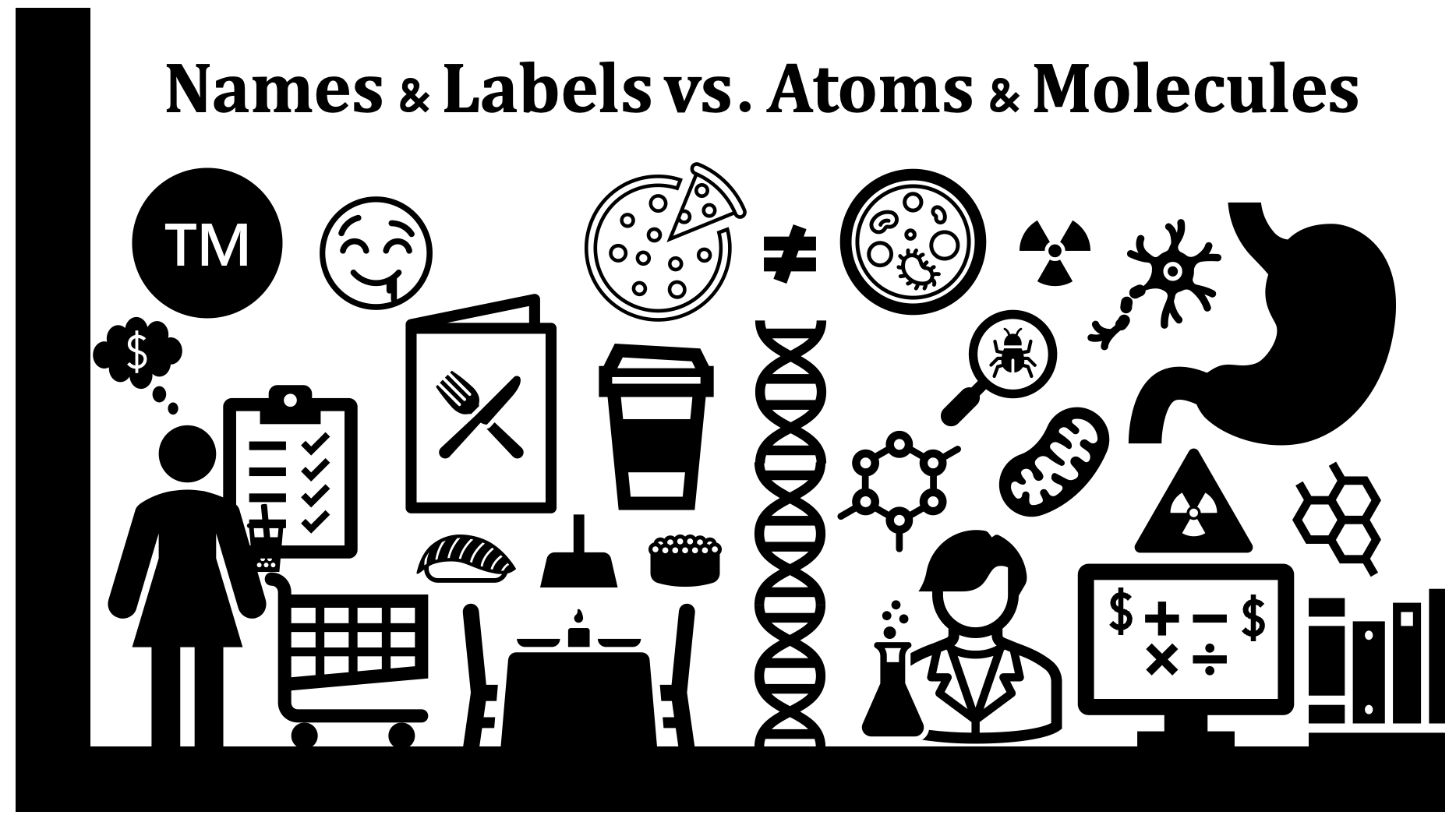
Despite a strong correlation, Traditional Food and Trade Food do not automatically translate into “healthy” and “unhealthy.”
This is because whether a Food is more “Traditional” or “Trade” isn’t a question of science or matter, but of the incentives underlying the production.
Incentives can help us to understand which substances, good or bad, may be in the Foods we eat — but it’s the chemistry that ultimately matters to our bodies.
Names and labels may provide some useful information, but they do not explain how the atoms and molecules entering our bodies may affect our longer-term health.
What’s in a name?
That which we call a rose by any other name would smell as sweet.
These famous Shakespeare lines can help us distinguish between how our minds interact with Food (names and labels), and how our bodies interact with Food (atoms and molecules).
Since their essence remains the same, the names and labels we ascribe to objects are unimportant. This was how Juliet understood her desire for Romeo, despite the longstanding feud between their respective families.
The fact that Romeo was a “Montague” could not affect how she felt towards him.
Juliet experienced Romeo through multiple senses — “Montague” was just a word that could be expressed as a sound or an image.
Her feelings came from the inside, from her own individual experience.
To Juliet’s family, however, the word “Montague” represented an external social reality that superseded Juliet’s feelings.
This reasoning is also applicable to Food.
The names and labels we ascribe to Foods have no bearing on how they affect our bodies and our health.
Just as the word “Montague” could not alter Juliet’s feelings for Romeo, the words we use to describe our Foods are unrelated to how the Foods affect us — unless, of course, those words happen to be scientific.
Names and labels can enter our minds and influence our decisions, but they cannot enter our stomachs or change our bodies’ chemistry. When we eat Food, we are ingesting atoms and molecules, not names and labels.
Wikipedia describes Food as “any substance consumed to provide nutritional support for an organism,” and which is “usually of plant, animal, or fungal origin, and contains essential nutrients, such as carbohydrates, fats, proteins, vitamins, or minerals.”
These, plus water, are the six essential nutrients.
But even these words are broad categories.
For example, fiber is a carbohydrate that could be considered a seventh essential nutrient due to its vital roles in digestive health and disease prevention.
But there are other carbohydrates of a very different nature: harmful substances that are not required by our bodies and can cause harm.
For example, refined sugars are added to Foods to enhance their taste.
More on that later.
Water (H2O) is present in all Foods and is the most abundant nutrient. Humans can survive weeks without solid Food, but only days without water.
Fats (lipids) have an oily texture and do not mix with water. These nutrients are found in both land and sea animals, vegetables, fruits like avocado and coconut, and nuts.
And as with carbohydrates, there are “good fats” (healthy) and “bad fats” (unhealthy).
Protein is what our bodies use to grow and repair themselves and can be sourced from both plants and animals.
Carbohydrates, fats, and proteins are the three primary types of macronutrients — they are the “fuel” sources which our bodies depend upon for energy.
Vitamins and minerals are micronutrients. These are required in smaller doses and are also vital to our bodily functions and development. Humans require thirteen essential vitamins which can be categorized as either fat-soluble (vitamins A, D, E, and K), or water-soluble (vitamins C, B1, B2, B3, B5, B6, B7, B9, B12).
Fat soluble vitamins are absorbed by fats within our body, allowing storage for future use. They protect vision, strengthen the immune system, support blood clotting, and provide antioxidants to fight inflammation.
Water soluble vitamins are carried to the body’s tissues but generally cannot be stored. They support energy production, create red blood cells, and prevent cell damage from metabolic stress.
Both fat-soluble and water-soluble vitamins are organic substances: they always contain carbon and are produced exclusively by plants or animals.
Our bodies also require sufficient minerals. Unlike vitamins, our bodies only require some of the known minerals. Dietary minerals are inorganic, less structurally complex than vitamins, and are also categorized based on how large a dose we need.
We require seven “macro” minerals: calcium, chloride, magnesium, phosphorus, potassium, sodium, and sulfur. The nine “micro” minerals we require are chromium, copper, fluoride, iodine, iron, manganese, molybdenum, selenium, and zinc.
Of the approximately four thousand known minerals on our planet, only sixteen are considered essential for human life.
All nutrients — micro and macro, organic and inorganic — are made of atoms, which can bond together to form molecules.
You may be familiar with the “periodic table of elements,” a single page document containing key elemental data that is used by chemistry students around the world.
Elements are comprised of one atom and are the simplest form of a substance. Since minerals may contain multiple elements, our four thousand known minerals are made up of different combinations of our one hundred and eighteen known elements.
Of these elements, however, only ninety-four are found naturally on earth.
This periodic table highlights the elements which are known to be essential to humans, as well as those which are suggested to be:
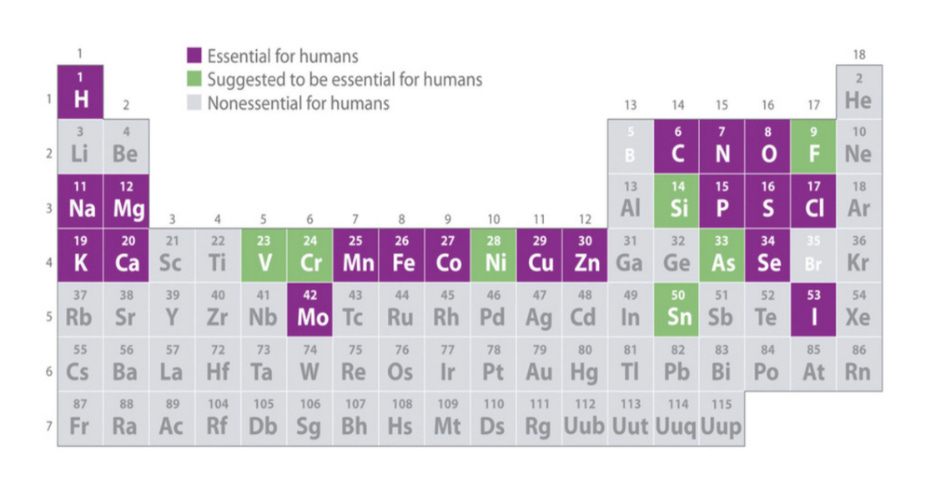
Given the scientific capabilities and achievements of our species, it is strange to encounter elements that are merely suggested to be essential to life.
We seem to have mastered our external world, but how much do we really know about human life and our physical bodies?
For this, we must explore the meaning of “nutrition.”