


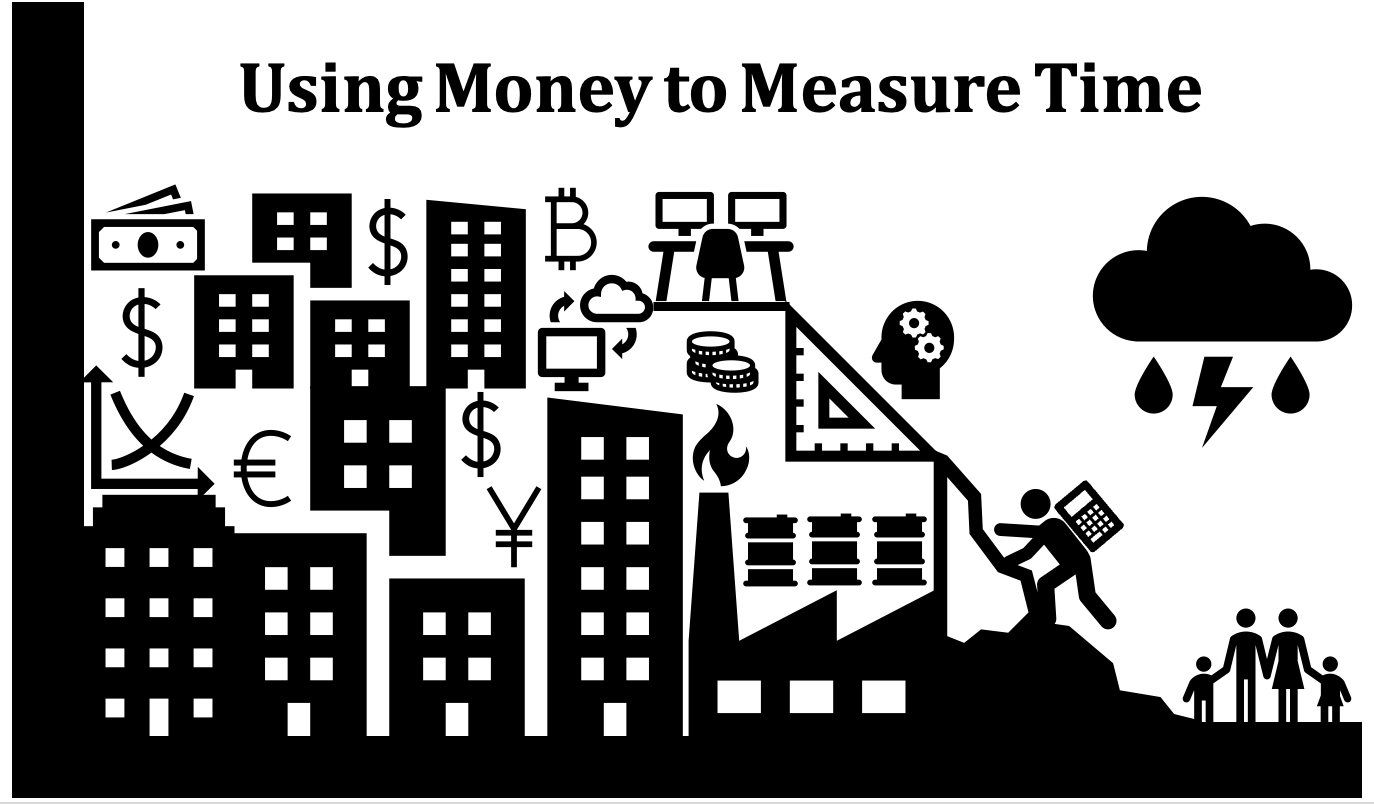
Measured Time and Human Time can be broadly mapped to physics and philosophy, respectively. But they can also be linked to two newer disciplines where Money and the human experience are central topics — economics and sociology.
Money will be introduced in Chapter 3, and its interrelations with Time and Food will be considered in Chapters 5 and 6, respectively. But it’s worth introducing economics now, as a way to further explore Measured Time and Human Time.
The word “economics” derives from the Greek “oikonomia,” but this earlier term referred to household management — not the broader “economy” as we know it today.
Economics became an academic discipline around 1776, when the Scottish philosopher Adam Smith (1723 —1790) published “The Wealth of Nations.”
Remembered as the “Father of economics,” Smith is best known for the concept of the “invisible hand” of the market. He viewed economics as the “science of wealth,” believing that the goal of every country should be to increase its riches and power.
The subject matter was not happiness, but wealth.
Some later economists would take issue with Smith’s conception of their field.
For Alfred Marshall (1842 — 1924), treating economics as the “science of wealth” erred by failing to consider the quality of human life altogether. To Marshall, economics was “on the one side a study of wealth; and on the other and more important side, a study of man.” Wealth was a means to the end of human welfare.
Other economists sought to distance their field from the concept of human welfare.
To Lionel Robbins (1898 —1984), economics was the science that studies human behavior as a relationship between ends and scarce means. It was about making choices in a context of scarcity.
Building on this idea, Paul Samuelson (1925 — 2009) would offer a more comprehensive explanation:
Economics is the study of how men and society choose, with or without the use of money, to employ scarce productive resources which could have alternative uses, to produce various commodities over time, and distribute them for consumption, now and in the near future, among various people and groups in society.
By treating Money as being optional to the task of resource deployment, Samuelson seems to be paying homage to our foraging ancestors.
Hunter-gatherers possessed a single scarce resource that could be used in many different ways: their Time.
We’ve already established that Money has become fundamental to modern human life. Conceiving of an economics without Money made little sense in 1961, when Samuelson was writing, much less today.
But his economics textbooks became bestsellers anyway.
Money enables humans to indirectly exchange goods with each other, mitigating the many logistical challenges associated with “barter,” where goods and services must be directly exchanged for one another.
This social innovation greatly expanded the human capacity for trade, forever altering the organization of our species. Our early use of Money set in motion tectonic shifts in how our species could, and would, use our Time.
Hunter-gatherers could use their Time in many different ways relative to animals. But while modern humans also require Food, we can use our Time to acquire Money in a seemingly infinite variety of ways.
This doesn’t mean it is easy to become rich — only that there are many different ways to convert one’s Time into Money, even if only a little.
Man has been described as “the measure of all things,” but Money is how our species measures the goods and services we produce and consume.
And this includes the use of our Time.
Economics is about measurement. Production, consumption, and the allocation of resources can all be measured with Money. Considering this, the economist Arthur Pigou (1887 — 1959) defined his field as:
that part of social welfare that can be brought directly or indirectly into relation with the measuring rod of money.
Money is one of two primary units of economic measurement. The other is Time.
The concept of “finance” — a profession which emerged from Money and banking — will be introduced in Chapter 5 (Time & Money). But before any investments can be made by bankers or corporations, the “goods” must first be conceived of by humans.
At some level, Human Time underlies all corporate production. But only the duration of Human Time can be measured.
We may use our subjective experiences to produce objective goods that can be measured with Money, but this is not a direct measure of our Human Time. And since Human Time can’t be measured, the concept is ignored by professional economists.
Within the field of economics, there is only Measured Time.
On the other hand, sociology is an academic discipline that explicitly concerns itself with human experience.
Quantitative methods may be used, but sociologists aim to understand things that are hard to quantify with Money: our behaviors, relationships, and institutions. They explore how humans experience their lives, and the causes of social change.
Both economics and sociology are concerned with human problems, but they diverge in their treatment of the concept of Time.
Economics casts the net too narrow by ignoring Human Time, while sociology casts the net too wide by attempting to synthesize many non-quantifiable aspects of social welfare, without sufficiently integrating the concept of Money.
No single academic field can help us navigate the complexity of modern living.
The Algebra of Life bridges this gap by taking an interdisciplinary approach that integrates both the quantitative (measurable) and non-quantitative (non-measurable) aspects of our lives.
To master this framework, we must strengthen our understanding of how our species’ social welfare is affected by Money, both directly and indirectly.
This begs the question: what is “social welfare”?