


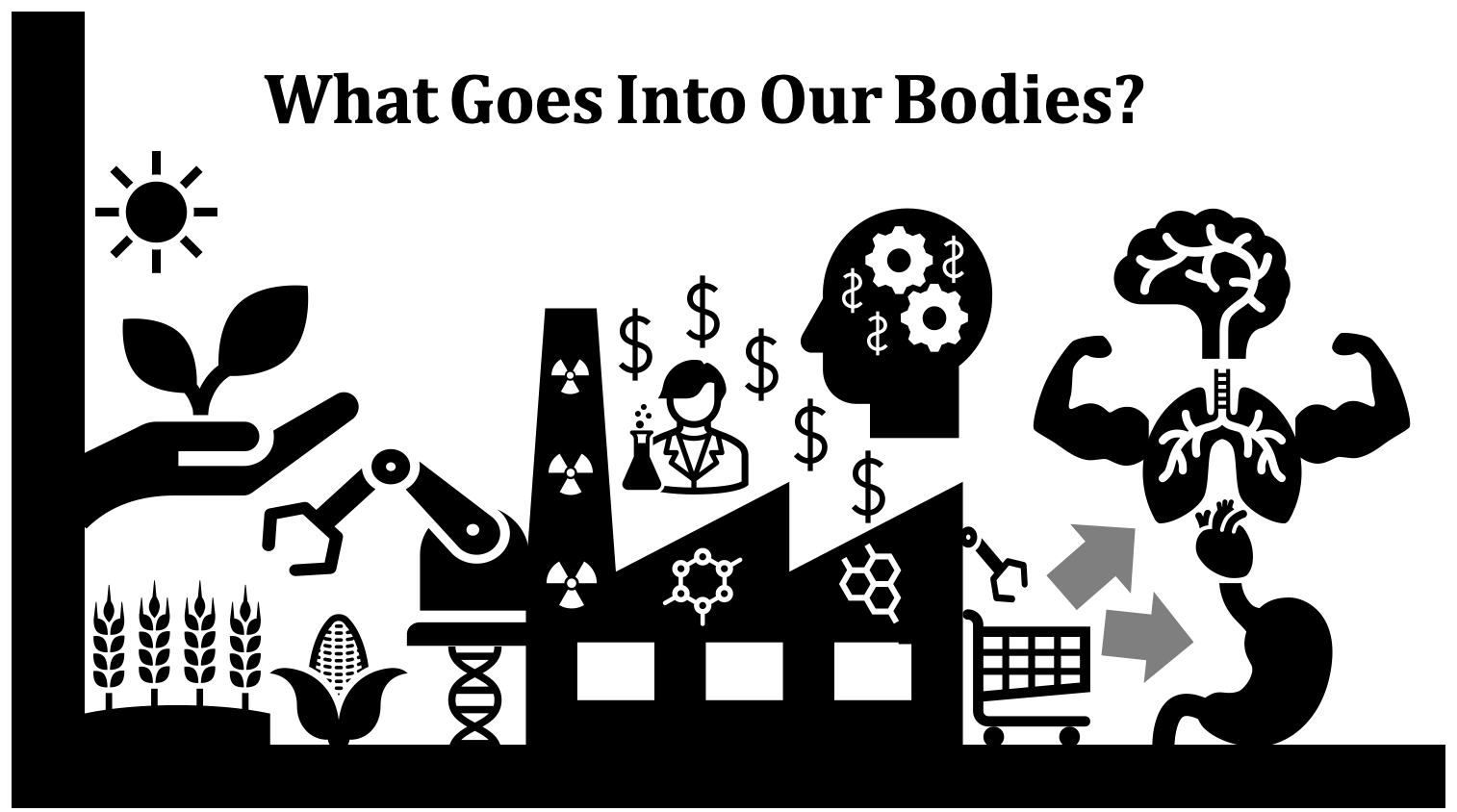
Within The Algebra of Life, Food is what goes into our bodies.
Nutrition involves more than getting enough of the right nutrients.
Rather, it is the study of how Food interacts with our bodies, with the goal of producing healthy and balanced humans — in both body and mind.
Apart from facilitating the growth, maintenance, and repair of our bodies, nutrition is critical for disease prevention throughout the course of our lives. It also supports our mental health and cognitive functioning.
Our everyday choices usually play the greatest role in shaping our nutrition, but there are some things we can’t control. Our genetics — inherited characteristics from our parents — shape how our bodies will chemically process the substances we ingest.
You may be thinking of “digestion” — the bodily process of breaking down Food into absorbable nutrients — but only a small portion of the chemical reactions happening inside of our bodies when we eat Food fall into this category.
Our circulatory, respiratory, and nervous systems handle our blood, air, and feelings, respectively — each involve many complex chemical processes.
But when we eat Food, there is a separate category of chemical reactions operating alongside digestion. This is our metabolism or metabolic system — the chemical reactions our body uses to convert Food into energy and to heal damaged tissues.
Parental influence does not stop with our inherited traits.
The Foods our parents chose to feed us, including the diets of our pregnant mothers, play an outsized role in our longer-term health. Our early life nutrition may permanently alter — for better or worse — our susceptibility to adult-onset diseases.
But this is ancient knowledge.
From the Arctic to the South Pacific, and from the Amazon to the Andes, every single indigenous group studied by Dr. Price had special nutritional guidelines and sacred Foods reserved for pregnant women, babies, and even soon-to-be fathers.
The forms this nutrition took varied based on each group’s local environment, but the same principles were being applied:
Certain Foods were to be consumed before conception, during pregnancy, and to support infant development. These included things like fish eggs, specific organ meats, shellfish, and insects — items now understood to contain high concentrations of vitamins and minerals.
“Nutrient density” has a specific scientific meaning today — the ratio of nutrients to energy contained within our Foods — but our earliest ancestors were not selecting their special Foods on this basis.
“Life-giving properties” are what was being sought, and our species’ relentless pursuit of these characteristics has preceded science by countless millennia.
These special Foods were, of course, “nutrient-dense,” but the early adopters couldn’t have known this. Dr. Price was applying this term long after these Foods were initially discovery and utilized by traditional human cultures.
Could this be the secret to achieving optimal health in our modern world?
Can we solve our metabolic problems by selecting Foods with high nutrient densities?
The answer is, unfortunately, not anymore.
For the traditional cultures encountered by Dr. Price, who still sourced their Foods exclusively from their natural environments in accordance with ancestral tradition, “nutrient density” would have been a near-perfect indicator of a Food’s healthiness.
This is because their Food was exclusively biological.
The modern commercial practice of mixing industrial chemicals with Food products to make them easier to sell for Money had not been invented yet.
In this context, “nutrient-dense” Foods were guaranteed to promote good health.
But the introduction of non-biological components to our Food has perverted the concept of nutrient density as it pertains to our actual health.
Nutrient density no longer captures everything that goes inside of our bodies.
Understanding what goes into our bodies, now, is fundamental to The Algebra of Life.
The following illustration offers a basic guide:
What Goes Into Our Bodies?
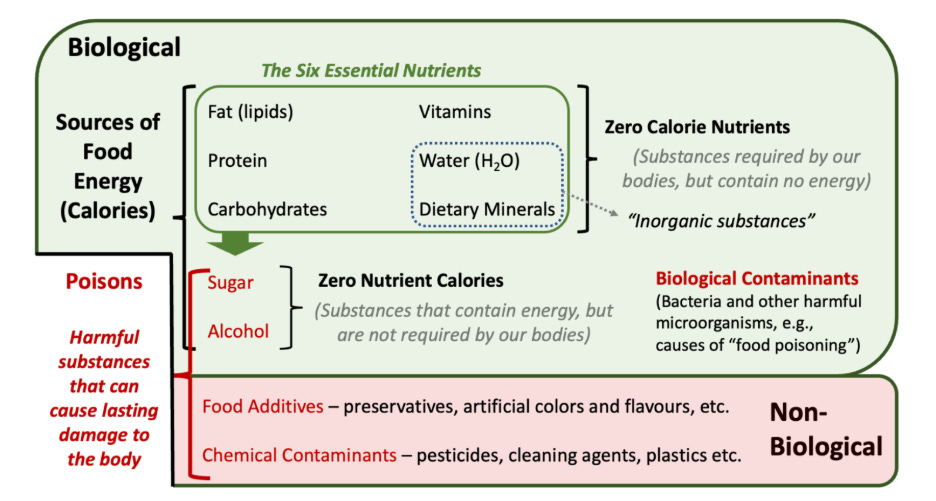
Eating a healthy diet involves more than just getting our required nutrients. We must also avoid harmful substances, particularly when the risk of damage is high.
Since our bodies require neither sugar nor alcohol, these are examples of “zero-nutrient calories.” On the other hand, water, vitamins, and minerals are examples of “zero-calorie nutrients” — our bodies require them, but they contain zero energy.
Both are captured by “nutrient density” because they are ultimately biological.
But modern Foods often contain many chemical substances which contain zero energy and cannot be classified as nutrients — these substances are non-biological.
And despite their potential to cause great harm within our bodies, they are not captured by modern measures of “nutrient density.”
The following table shows how many calories are contained within one gram of each source of Food energy:

But calories are not a measure of nutrition — for that, we must consider everything that goes into our bodies.
That is what “Food” means within The Algebra of Life.
How this concept relates to the others will be explored in Chapter 4 (Time & Food) and Chapter 6 (Food & Money) of Part II.
But first we must introduce Money — this is the subject of Chapter 3.