


Modern humans often select their Foods based on two primary factors:
Taste — the sensation of flavor perceived upon contact with a substance; and
Price — the amount of Money that must be paid to receive the item.
As adults, we rarely have to determine whether something is Food.
Modern grocery stores handle this now.
Once inside, we take for granted that everything for sale counts as “Food,” and so we reasonably assume it is all safe to eat.
Nature offered no such safeguards to hunter-gatherers, who were forced to master the processes by which nutrition could be extracted from their local environments.
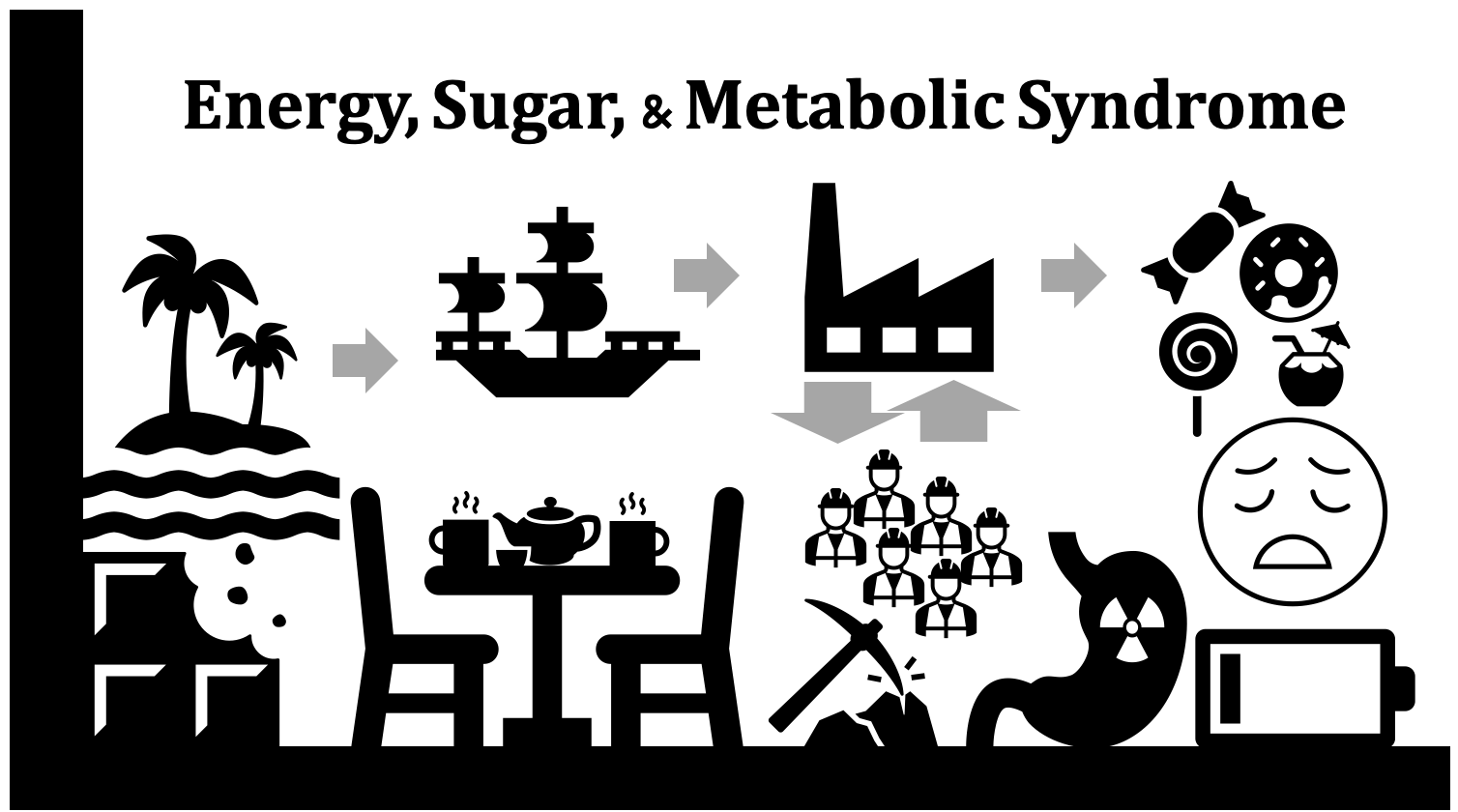
During the Second Agricultural Revolution, as Food was increasingly produced to be exchanged for Money (Trade Food), many European nations intensified their efforts to extract Money from the foreign lands under their control.
Our species has traditionally selected Foods based on whether they produce healthy and balanced individuals, but the European nobility and wealthy landowners were beginning to ask different questions.
What is the most profitable use of our land?
Which Food can be sold for the most Money?
The answer turned out to be sugar.
But this was not a new experiment.
The Caribbean “Sugar Revolution” of the late 17th century came before Britain’s Second Agricultural Revolution, and under very different circumstances.
The 18th century boom in European agricultural productivity was initially applied to many different local crops, making Food cheaper in general by lowering costs. The Sugar Revolution had nothing to do with feeding the Caribbean’s local inhabitants.
In fact, and without exception, the availability of local Traditional Foods was severely displaced wherever sugar plantations were introduced. These plantations were also the main drivers of human slavery during this era — both topics are for later Chapters.
There was so much Money to be made from selling this edible, “white gold,” that by the end of the 17th century, many other European nations had followed the Portuguese and Spanish in establishing their own overseas sugar plantations.
What was once a rare, luxury spice had become a globally traded commodity.
But why were people buying it?
What was sugar being used for?
The most widespread use was sweetening hot beverages — tea, coffee, chocolate — which were formerly much less palatable to Western Europeans. These caffeinated products had originally come from the East but were popularized by Caribbean sugar.
With bulk imports driving prices down, sugar became the main ingredient in candies, pastries, jams, and other preserves. Entirely new categories of Food products were made possible by sugar, which could apparently make Food last longer and taste better.
The term “confectionary” originated in medicine, to describe remedies utilizing sugar or honey to make certain medicinal substances more palatable.
But once bulk imports crashed sugar prices — making it a highly profitable Food additive — the term came to be associated with cheap, sugar-laden Food products.
Confectionary became another word for candy store.
Large-scale sugar production created a syrupy byproduct known as “molasses.” This substance retained a modest nutrient profile and could be used as a sweetener — but its most common and profitable use was to make rum.
Rum is an alcohol, a special category of Food that will be covered in the next post.
At a higher level, when it came to the “bigger picture” uses of sugar, European royalty and their merchant affiliates harbored a different perspective:
Sugar represented cheap energy for the industrial working class.
This edible commodity served as the financial engine of multiple European Empires by becoming cheap fuel for human bodies. It remains among the most widely traded physical substances in the world today.
The energy contained within our Food is measured in calories.
A “calorie” has a specific meaning within science — it is the approximate amount of energy needed to raise the temperature of one gram of water by one degree. But our modern use of the term has taken on a life of its own.
Calories are the primary metric by which modern humans measure their Food.
We use Money to measure the price of our Foods. Calories are technically a measure of energy, but we have come to associate this measure with health.
Foods with “low” or “high” calorie contents have become cognitively linked to “healthy,” or “unhealthy,” respectively.
But calories cannot be used to measure nutritional value.
Understanding the distinction between the energy and nutrition contained within our Foods is fundamental to The Algebra of Life.
Calories are how we would measure the heat that would be produced if we set our Foods on fire, but that is not what is happening inside of our bodies.
The energy contained within our Food has very little to do with nutrition.
From the perspective of European royalty and their merchant affiliates, however, there was an Industrial Revolution to manage.
Their factories needed workers.
Sugar consumption exploded during this period (1760 —1840) because it was the cheapest way for many newly-disenfranchised factory workers to secure the energy their bodies required to make it through the grueling workday.
These workers often had to accept the cheapest available sources of calories just to ensure their families had enough to survive.
Today, our consumption of sugar looks very different.
Modern humans eat sugar because it tastes good and is cheap. Corporations add sugar to their products for the similar reasons, using science to maximize flavor and “shelf-life” while minimizing costs.
But since these new, sugar-laden Trade Foods offer more powerful sensations of flavor at lower prices — displacing many Traditional Foods in the process — our species’ consumption of sugar has skyrocketed.
We’ve eaten far too much sugar, for too long.
The result has been metabolic syndrome.
Capturing several related conditions that increase the risks of heart disease, stroke, and diabetes, metabolic syndrome is our species’ primary chronic health problem.
Public health authorities regularly link metabolic syndrome to obesity and inactivity, but this energy-centric explanation does not tell the whole story.
The problem is more about a lack of nutrition than a lack of exercise. It has to do with our metabolism: how our bodies chemically process the things that go into them.
In the next post, to close Chapter 2, we’ll provide an overview of what goes into our bodies.