


Part II: Dualisms
“The quality or state of being dual or of having a dual nature”
“The division of something conceptually into two opposed or contrasted aspects, or the state of being so divided”
“A theory or system of thought that regards a domain of reality in terms of two independent principles”
“A theory that considers reality to consist of two irreducible elements or modes”
“The use of two irreducible, heterogeneous principles (sometimes in conflict, sometimes complementary) to analyze the knowing process”
“A view of human beings as constituted of two irreducible elements”
— Selected definitions
The word dualism is a combination of the Latin “duo,” or two, and the suffix “ismus,” meaning a system or theory.
Though often associated with René Descartes’ mind-body theory, it was the English linguist Thomas Hyde who first coined the term in 1700 while studying ancient Persian religion — he had used it to describe the cosmic battle between good and evil.
In theology, dualism stands for a reality that is divided into equal but opposite forces.
Persia’s Zoroastrian conception of eternal struggle was between Ahura Mazda, creator of truth and light, and Angra Mainyu, the force of chaos and darkness.
For its part, Christianity involves a dualistic framework of good and evil but rejects the idea of an eternal struggle between them. Instead, evil represents a temporal corruption of the good that will eventually be overcome.
In Ancient China, dualism meant the balancing act between two complementary forces rather than direct conflict. The Yin and Yang of Taoism did not represent good and evil, but the equilibrium produced by the interplay of light and dark forces.
Beginning with Plato in Ancient Greece, the idea that our minds and bodies are fundamentally distinct is known as substance dualism. It was later famously modified by Descartes, and is shared by many world religions.
Science has since proven many of Descartes’ beliefs wrong.
Living amidst the Scientific Revolution, Descartes was a pivotal figure in the histories of science, math, and philosophy. His Cartesian coordinate system revolutionized geometry, and he was among the first to mechanically model the physical world.
But his love of automation and mechanization led him to adopt many views that would be considered absurd by today’s standards.
For example, since they lacked human language and cognition, he believed animals to be unthinking machines, incapable of feeling pleasure or pain.
This was roundly mocked by Enlightenment thinkers including Voltaire, Bentham, Leibniz, Hume, and Rousseau — men perhaps more in touch with their inner worlds.
Everyone knew dogs had feelings.
But even Descartes himself had a pet dog that he loved dearly — his private actions did not accord with his public views.
As a man of science, his view of animals was likely an instrumental belief intended to absolve scientists from the moral quandaries surrounding animal experimentation — particularly where their treatment could be characterized as torture.
Instrumental beliefs are caused by incentives — the motives, rationale, or strategy behind our actions. These feature prominently in Part II.
When concepts collide, incentives are both a cause and effect. The strongest incentives are often the basis of great and lasting change.
This is the meaning of “dualism” within The Algebra of Life.
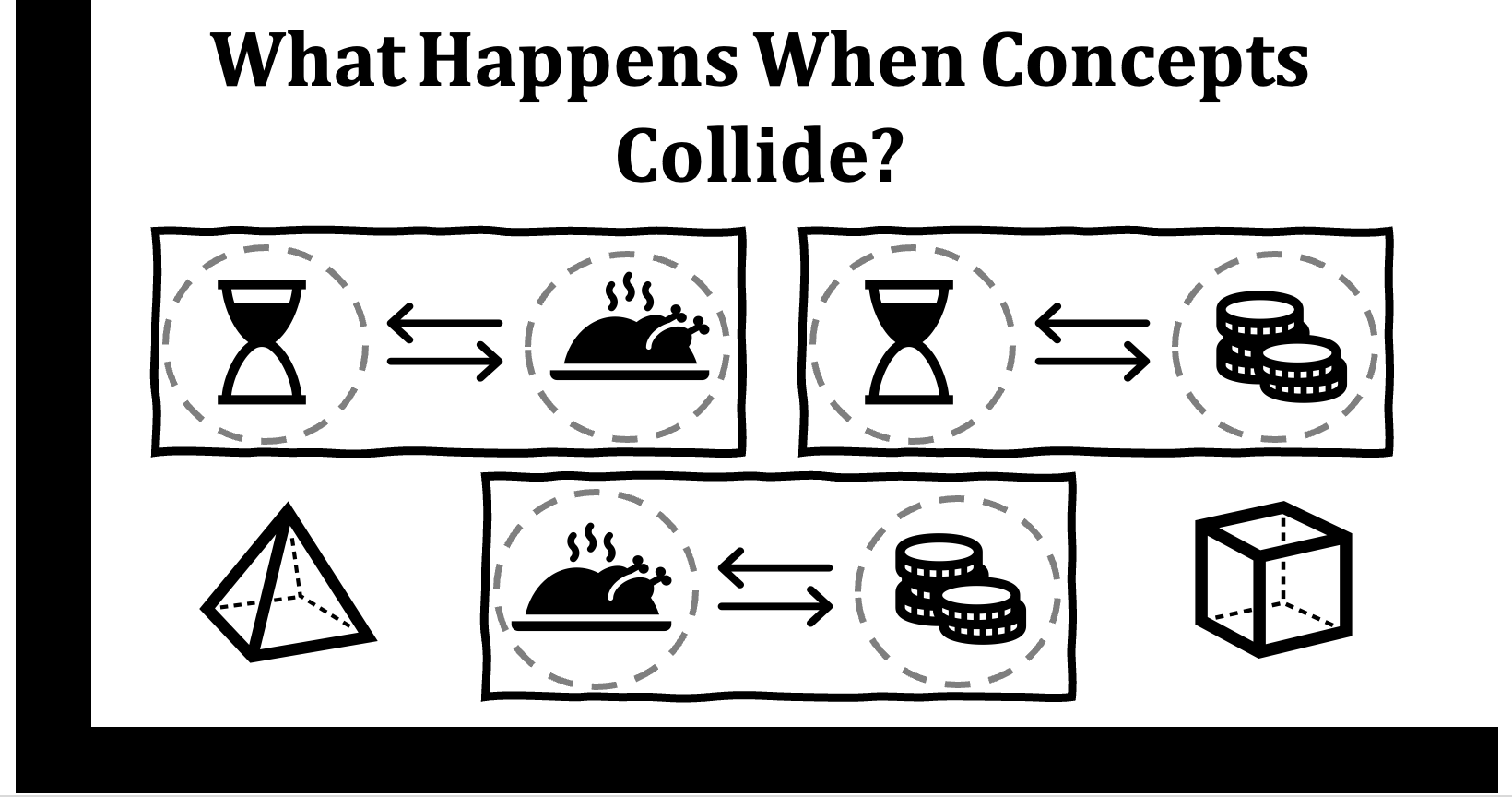
Instead of dividing the world into balancing halves or opposing forces, the “dualisms” of Part II are the products of interplay within the respective pairings of concepts:
Time & Food (Chapter 4)
Time & Money (Chapter 5); and
Food & Money (Chapter 6)
As rigidly independent concepts, the interactions between Time, Food, and Money cannot alter their core meanings to our species.
But these interactions have been highly consequential throughout our species’ history and development, shaping the trajectory of our civilization and culture.
Some Foods may have been temporarily used as Money, but Food and Money will always remain distinct concepts to our minds — and especially to our bodies.
Their dualistic interplay, however, produces many lasting effects.
The transition from Traditional Food to Trade Food, long underway, is a product of the Food & Money dualism. Our modern Food supply and grocery stores emerged out of repeated collisions between the concepts of Food and Money.
The phrase “Time is Money” was popularized by Ben Franklin, but what he really meant is that using one’s Time to acquire Money (legally) is better than sitting idle.
Jobs, banking, and business fall under this dualism, along with all public, private, and household financial matters. When Time and Money collide, you get salaries, taxes, insurance, mortgages, loans, retirement plans, and many other products and services.
Finally, the collisions between Time and Food, the oldest of Part II’s dualisms, have produced two separate agricultural revolutions, many millennia apart. Developments within our bodies and minds are also included here, in both the short- and long-term.
These primary dualisms form the basis of the next three Chapters, but there are also several important secondary dualisms that come into play in Part II.
The same two-way dynamics apply, but with narrower concepts or perspectives. For example, operating alongside Time & Money is the secondary dualism of humans & corporations — with its own complex interplay of psychology and incentives.
Other secondary dualisms are formed when Money is added to politics, law, science, medicine, or education. Or replace Money with “technology,” or “culture,” and you get two more sets of dynamic systems with dualistic properties.
Many of these secondary dualisms deserve their own books — particularly humans & corporations — but their role within Part II is to help us pinpoint the underlying mechanisms operating within the broader Algebra of Life framework.
Part I was about laying the foundation.
Part II is about building and scaling our understanding.
With the concepts clarified, we are ready to begin working with two variables.