


This Chapter’s division of Money into “First,” Artifact, Metallic, and Fiat is only loosely chronological.
These categories were introduced to highlight Money’s complex origins, shifting nature, and how it evolves alongside our species and civilization.
To make sense of these changes, we must understand the difference between a Money’s form — the physical (or non-physical) representation — and its basis — the reasoning behind the system, or why the form should be trusted.
As a recap, the “First” Money lacked any physical form.
Its basis was human reciprocity and survival instinct — both short- and long-term.
Artifact Money has taken many different physical forms and was based on general acceptability. But as the West African bead holders would painfully learn, its scarcity was only temporary and not enduring.
Metallic Money has evolved considerably, affecting both its form and basis. It shifted from fragments of precious metals to standardized coins, where the form and basis were the same: metal.
But once paper receipts began circulating, the form and basis of Metallic Money began to diverge.
The new form was paper, and a layer of trust was added to the metallic basis — gold was no longer contained within the Money itself but stored with its issuer.
As issuers created more Money than could be supported by their gold reserves, the basis of trust gradually collapsed, culminating in our current era of “Fiat Money.”
It formally began with the Nixon Shock of 1971 but was set in motion by the 1913 Federal Reserve Act. More than any other institution, the United States Federal Reserve led the global transition away from Metallic Money and towards a fully fiat system.
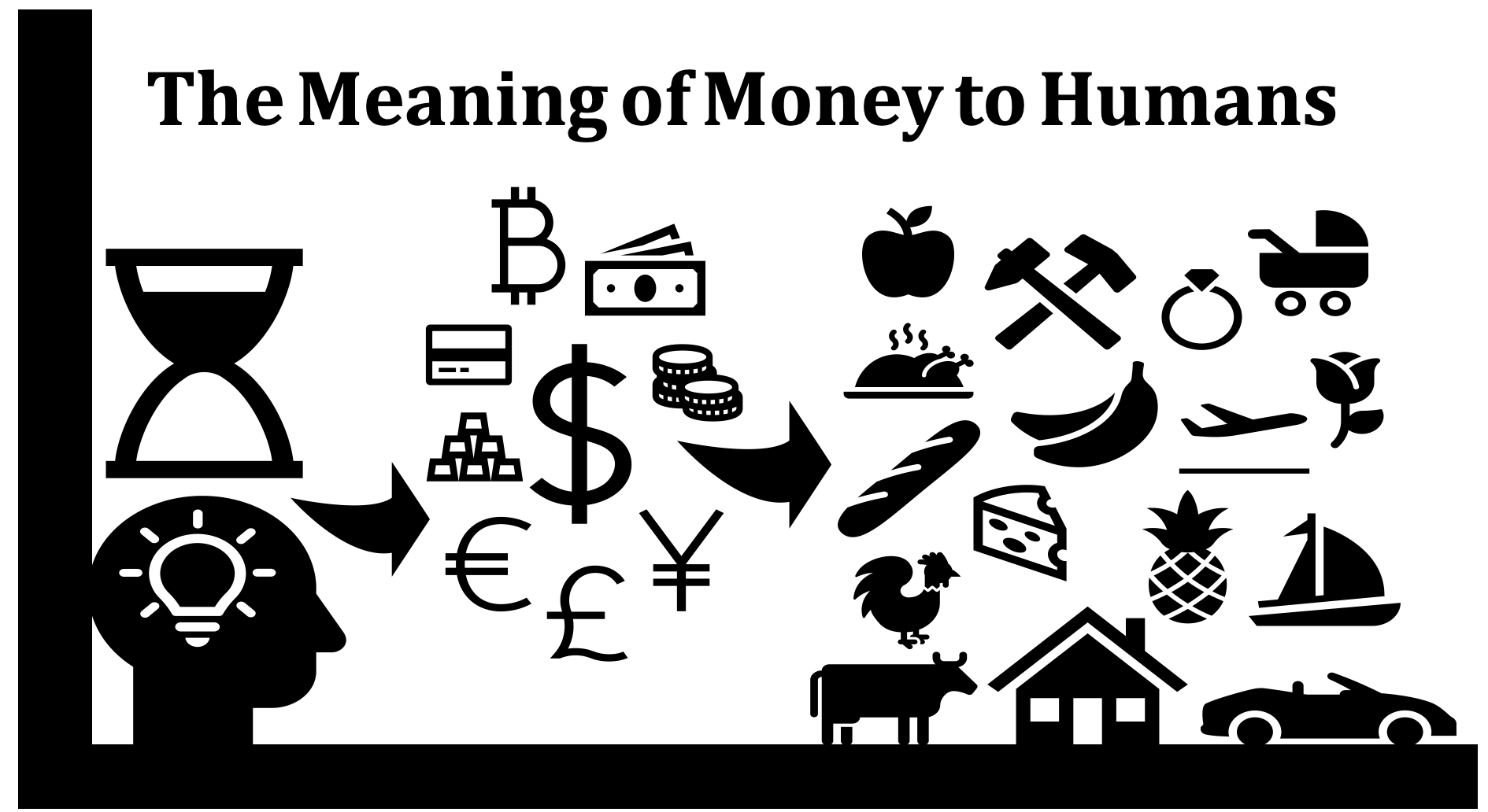
Throughout these changes, the core meaning of Money to our species has remained the same: Money is how humans intermediate between Time and Food.
This explanation is timeless, specifying neither the form nor basis, while capturing the long-enduring relationship between Money and human life.
This is more than an accurate description of Money — it’s an appropriate definition.
We all possess Time.
We all require Food.
These were the original “supply” and “demand” curves governing early human economics. And since we can no longer be hunter-gatherers, our nourishment can no longer be sourced directly from nature.
Our Time must be used to acquire Money, with which we can buy Food. We exchange our Time for Money in order to buy Food — these are the “trading pairs” of modern human life.
A medium of exchange is required to both receive value for our Time, and to regularly purchase Food.
We require a store of value because our need of Food will typically outlast our ability to receive Money for our Time — our Money must still “work” in the future.
Standardized units of account facilitate both purposes by enabling record keeping.
The meaning of Money to humans is not inconsistent with its meaning to corporations or professional economists — it’s just a different perspective.
But this perspective is rarely voiced in the halls of power.
Money means something different in the boardrooms of large corporations and war rooms of major governments, where profit and control take center stage, respectively.
But if our system of Money is repeatedly optimized for financing corporate takeovers and funding wars, this will interfere with our species’ intermediation between Time and Food.
Our Money has not yet “failed” — but we receive little for our Time, and the same Money cannot buy as much Food as it used to. Much of the world is now like this.
With Fiat Money, our species has grown accustomed to steadily rising prices.
The general increase in prices over Time is known as “inflation.”
This feature of Fiat Money is why national currencies function poorly as a long-term store of value, which causes many savers to seek alternatives.
Culture and politics influence these financial choices.
For example, households in India have been relying on physical gold for this purpose for more than five thousand years.
In the United States and Canada, however, only a small minority use gold to store value. Instead, the preferred long-term savings vehicles in these countries are corporate stocks and residential homes, respectively.
Despite ownership being concentrated at the top, a greater percentage of American citizens own corporate stocks than that of any other country, and by a wide margin.
Americans first began trading stocks in the late eighteenth century, but the expansion of public ownership is a more recent phenomenon that came with the United States government’s aggressive legislative push towards stock-based retirement plans.
These changes came in the late 1980s in response to the preceding “Great Inflation,” where the then-existing corporate pension system was essentially wiped out. From then on, the retirement plans of most Americans would depend on the stock market.
In Canada, mass-reliance on residential housing as a long-term store of value is an even newer phenomenon.
During the early 1990s, an economic downturn had similarly wiped out the prevailing pension system, but Canadians turned to housing for a number of reasons: favorable tax treatment and other incentives, cheap debt, and market deregulation.
These changes also made housing an attractive financial asset — more on that later.
India, the United States, and Canada each have their own national currencies, but their citizens’ respective uses of gold, stocks, and housing as long-term stores of value also make these things fall within the domain of Money.
Within The Algebra of Life, the concept of Money is not confined to currencies — it includes all the mechanisms by which value is stored, invested, or transferred.
Finally, to conclude Part I’s introduction to Time, Food, and Money as concepts:
Is something Money because we use it as Money?
Or do we use things as Money because they are Money?
Unlike with Food, the answer is the former.
Anything can become Money if humans begin to use it that way.
Money is defined by human behavior.
Food is not.