


The word “Money” carries a lot of baggage.
Some people believe it is the root of all evil, while others may develop an unhealthy obsession with it.
In the Bible, Jesus is reported to have thrown the “Money Changers” out of the temple. And gambling — wagering or playing games of chance to either win or lose Money — has traditionally carried a negative social stigma.
But even if all of this is true, it does not change the core meaning of Money to our species:
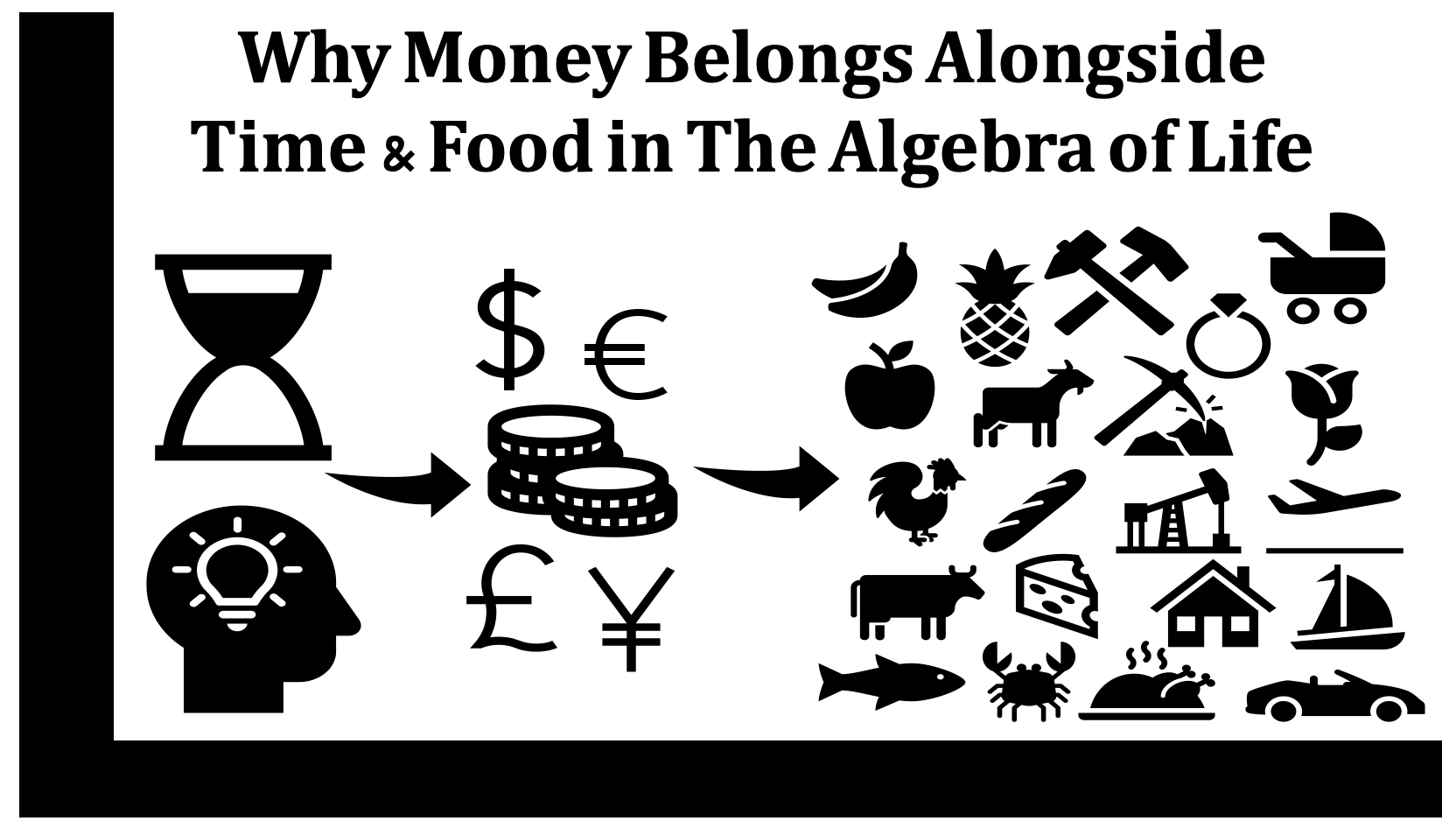
It is how we intermediate between Time and Food in the modern world.
Losing sight of this has already caused much human suffering throughout our history, but things could get worse if we forget altogether.
This uniquely human function of Money has been taken for granted amidst a modern preoccupation with the corporate and political functions of Money: profit and control, respectively.
The meaning of Money to humans has also been obscured by being subsumed within the overly broad and technical economic definitions that some people learn about in school.
Money is, of course, used as a medium of exchange, a store of value, and a unit of account.
This description is not wrong.
There are clearly many other uses of Money besides our species’ intermediation between Time and Food.
But from a human perspective, this doesn’t tell the whole story.
By being so inclusive as to cover all types of value transactions by both living (humans) and non-living transacting entities (corporations, governments, etc.), the economists’ standard explanation of this ubiquitous concept fails to capture the fundamental relationship between Money and human life.
Time and Food were the original “supply” and “demand” curves governing early human economics. We all possess Time, and we all require Food.
And ever since the Second Agricultural Revolution, virtually all humans must use Money to intermediate between the two.
There are exceptions, such as where the activity of prior generations causes some humans to be born into situations where there is already enough Money to provide Food for a lifetime.
But in most parts of the world, and in most neighborhoods, this is uncommon.
Our species’ intermediation between Time and Food is what makes the use of Money a uniquely human characteristic, relative to all other life forms.
Prominent in all advanced civilizations, the use and recognition of Money is a key difference between humans and animals, reflecting our incomparably wider scope for planned action.
Modern systems of Money facilitate the global exchange of many different non-living and inedible products, such as stocks, bonds, currencies, gold, oil, digital assets — or, for that matter, anything made of plastic.
Non-living transacting entities certainly do most of the trading, and the dollar value of these transactions likely dwarfs that of the human exchanges of Time for Money and of Money for Food.
But it is only these latter transactions, the “Trading Pairs” of human life, which capture the core meaning of Money to our species.
This framing does not capture all of Money’s different uses, but it captures something that is conceptually more important than all these other uses combined.
Our species’ intermediation between Time and Food is the foundation of everything that came after our hunter-gatherer heritage.
No matter your politics, and no matter how you might personally feel about what you know as “Money”, the relevance of this concept to modern human life cannot be denied.
This is why Money belongs alongside Time and Food as the third variable within The Algebra of Life.
But the order is also important: Time, Food, and then Money.
If Money is how humans intermediate between Time and Food, then the meaning of Money to our lives derives exclusively from the extent to which it enhances our lives in either of these domains.
For all humans, Money is only useful to the extent that it ultimately enhances our lives in the domains of our Time or our Food.
But as we will soon learn to better appreciate, these are extremely broad domains for humans.
Next Post: Scoping the Variables of The Algebra of Life
Previous Post: From Imagination & Experimentation to Importation & Exportation