


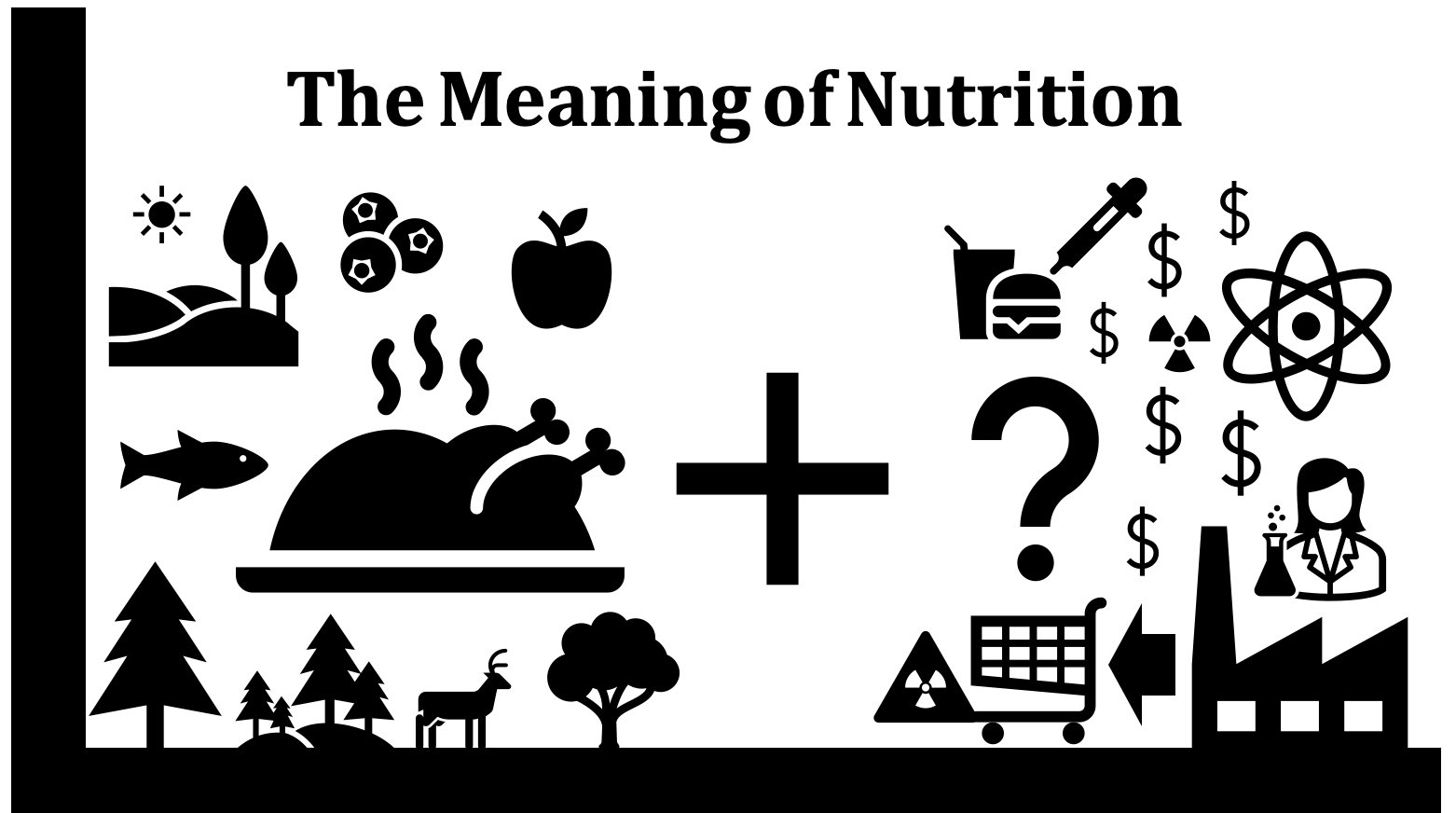
Chemistry, physics, and biology are the sciences of matter, force, and life, respectively.
Our known elements can combine to form a seemingly infinite variety of molecules and compounds — “matter” — but many chemicals have nothing to do with life.
When we consider only the chemical processes within and relating to living organisms, we get biochemistry.
But there is also something called “Food chemistry,” which Wikipedia describes as:
The study of chemical processes and interactions of all biological and non-biological components of foods.
Organic and inorganic substances have been introduced, but the difference between “biological” and “non-biological” is a separate distinction. Inorganic dietary minerals play many roles within our bodies — non-biological must mean something different.
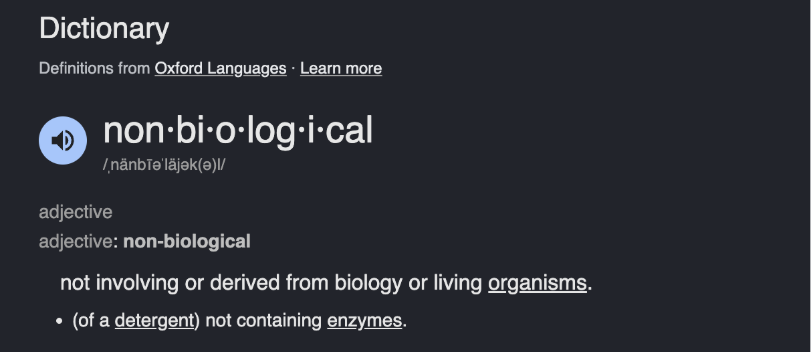
But why would ingredients with nothing to do with life ever be added to our Food?
What are the non-biological components of our Food?
Can we identify them from Wikipedia’s extended description?

The first sentence refers to the non-biological components of our Food, but the second and third sentences are a source of confusion.
By categorizing meat, poultry, lettuce, beer and milk as “biological substances,” and then grouping together water, vitamins, minerals, enzymes, food additives, flavors and colors as things that are “also included,” this description avoids directly naming the non-biological components of our Food.
Water, vitamins, dietary minerals, and enzymes are all “biological” — they perform vital functions within our bodies.
This leaves “food additives, flavors, and colors.”
But flavors and colors are among the most common substances added to our Food!
In general, the non-biological components of our Food are food additives. These substances are added to our Foods for reasons unrelated to our nourishment. If served alone, they would not be considered Food. But we eat them anyway.
Categorizing meat, poultry, lettuce, beer and milk as “biological substances” isn’t wrong, but it’s unlikely to be the whole truth.
Each of these terms represents a Food item that should be composed of primarily biological substances, but it would be highly unusual for such complex groupings of atoms and molecules to be completely free of non-biological additives.
Biochemistry is all about life-related chemical processes and substances, but Food chemistry implies the use of non-biological components within our Foods — often for commercial reasons.
The subtle gap between biochemistry and Food chemistry is bridged by the concept of nutrition.
This word may sound scientific, but dictionaries offer a variety of descriptions:
The biochemical and physiological process by which an organism uses Food to support its life;
The process of providing or obtaining the Food necessary for health and growth;
The branch of science that deals with nutrients, particularly in humans; and
Nutrition is about eating a healthy and balanced diet.
The first description acknowledges that nutrition is not just biochemistry, but also physiology — the study of how our organs and other internal systems function.
Biochemistry is the foundation for our physiology, but we are far from understanding all the mechanisms by which the former can influence the latter. Balancing chemical equations on paper is different from mapping the chemical reactions in our bodies.
The problem with the second description is the inclusion of the word “necessary.” This implies that unnecessary Food items — such as candy and soft drinks — would fall outside the scope of “nutrition.”
That can’t be right.
The third description has a similar problem. While the Foods we eat generally contain nutrients, they also include physical substances which cannot be classified this way. And our bodies must process everything that goes inside of them.
It is also contradicted by Wikipedia’s description of nutritional science:
...the science that studies the physiological process of nutrition, interpreting the nutrients and other substances in Food in relation to the maintenance, growth, reproduction, health, and disease of an organism.
Ultimately, the fourth description would be the most accurate definition.
Nutrition is about eating a healthy and balanced diet.
But this is still vague.
Accuracy is different from precision, which is why the ‘devil’ is in the details.
The words “healthy” and “balanced” can be used scientifically — for example, to denote healthy levels of a certain vitamin, or a balanced intake of macro-nutrients. But they can also be used more subjectively.
Long before modern science, chemistry, or the dissemination of any government-prescribed “healthy and balanced diet” (e.g., “The Food Guide Pyramid”), our species had a different, more ancient conception of nutrition.
Humans have traditionally selected and consumed Foods that produce healthy and balanced individuals. There was no concept of a healthy and balanced “diet.”
As Dr. Price would come to appreciate, the selection of Traditional Foods had long ago been perfected — without the use of science.
And if our earliest ancestors had possessed the tools of science and applied them to Food selection, it would have been pure biochemistry rather than Food chemistry.
The Foods made available by nature may not have always been safe to eat, but they were always biological. They contained zero non-biological components such as artificial colors, flavors, or preservatives.
Adding non-Food substances to our Food is an exclusively human behavior that is rooted in our species’ use of Money.
This relatively new phenomenon is unfortunately driven by law and economics rather than nutritional science — more on that later.
The implications for human health have been dramatic.
Nutrition is not just about nutrients. Eating a healthy and balanced diet also means avoiding substances that can harm our bodies.
Next, we’ll explore some of the problems caused by sugar.