


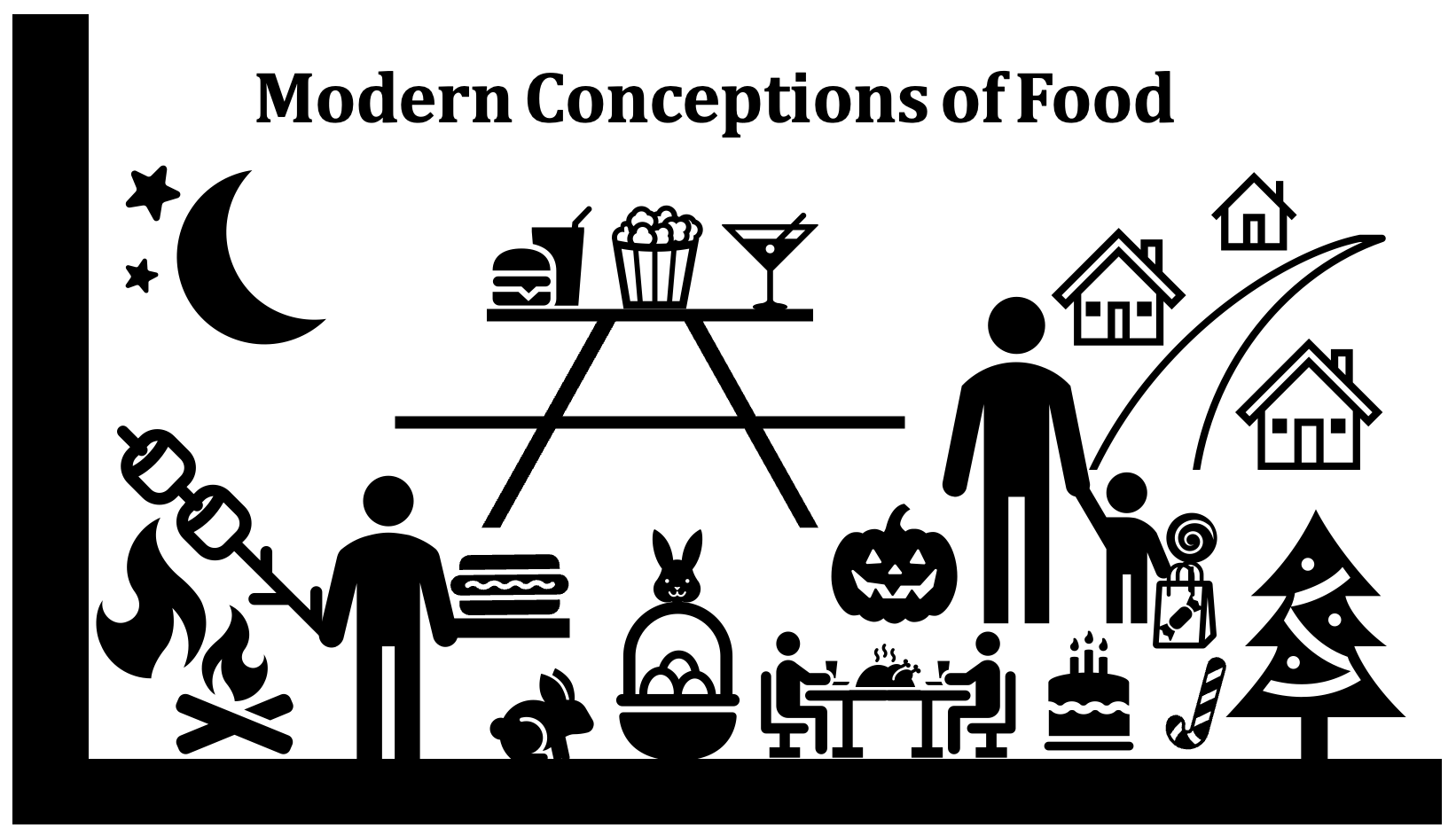
Within The Algebra of Life, the domain of “Food” includes much more than what we choose to eat and drink.
It includes everything that goes into our bodies.
But even the Foods we choose to eat can be conceived in different ways.
Humans and animals have broadly similar biological relations with Food — we require it to survive so we must work to acquire it, whether directly or indirectly.
But in addition to the wider range of Foods that humans eat, we also speak and think about Food with a richer knowledge base and vocabulary.
On one hand, there is Food as we know it, or the “colloquial conception” of Food.
This is the basic, everyday language we use to describe the things we choose to eat and drink.
These are words like breakfast, lunch, dinner, eggs, pizza, apple, hamburger, or Coca-Cola.
This is the most common way that modern humans think and speak about Food.
But there is also Food as nutrients or harmful substances: the “scientific conception.”
This language is more detailed, relating to the specific physical substances entering our bodies which may provide — or interfere with — the nourishment needed for growth and the maintenance of life.
With the scientific conception, we use words like proteins, fats, and carbohydrates, but even these are only starting points.
Although broadly compatible with science, these terms ultimately still represent categories of substances within which there is great variety.
For example, carbohydrates include both watermelon and watermelon-flavored candy. But our bodies will produce very different chemical reactions for each item.
Food “as a domain of life,” Food “as we know it,” and Food “as nutrients or harmful substances,” are not distinct categories of Food, but different ways that humans can conceive or think about Food.
Unlike animals, our species conceives Food not only biologically, but also through cultural, psychological, and economic lenses.
While some animal species like the Koala or Giant Panda are limited to a single Food — eucalyptus and bamboo, respectively — for a purely biological purpose (survival), humans fall on the other end of the spectrum.
Food has taken many different physical forms throughout our species’ history, but the concept has also been imbued with different meanings:
Food as medicine: In both India and China, ancient systems like Ayurveda and Traditional Chinese Medicine have long emphasized the role of diet in healing, disease prevention, and wellness.
Food as art or entertainment: In the more expensive restaurants of modern cities, the act of eating has become a curated, multi-sensory experience, where meals are designed to create excitement.
Food as culture or identity: Preparing local, customary Foods can be a vessel for heritage and belonging by preserving indigenous histories and celebrating religious holidays.
Food as comfort: If we’re feeling sad or stressed, Food can be used for psychological soothing, particularly if the Food is associated with childhood or home cooking.
Food as connection: The act of eating can be treated as an opportunity or catalyst for bonding, such as with business dinners, romantic dates, family barbecues, or holiday feasts.
Food as politics: We’re the only species that uses Food choices to reflect our political or ethical values. For example, eating “vegan,” seeking out “fair-trade” products, or shopping locally to minimize our “carbon footprint.”
Food as status symbol: Going beyond art or entertainment, the inclusion of rare or expensive ingredients and exclusive restaurant reservations have long been a signal of wealth or social standing.
Apart from the ancient conception of Food as medicine, these other conceptions of Food relate to the human mind.
But our minds and bodies relate to Food very differently. And since our minds don’t have to follow the same rules as our bodies, many of these varied conceptions of Food are relatively new to our species.
Food was much simpler for our early ancestors.
This difference is best captured by introducing two distinct conceptions of Food that are based on the purpose of their production.
Traditional Food is produced to be eaten. Trade Food is produced to be exchanged for Money.
Just as Time was broken down into “Measured” and “Human,” Food must be broken down into “Traditional” and “Trade.”
This distinction goes beyond modern conceptions and is fundamental to The Algebra of Life.