


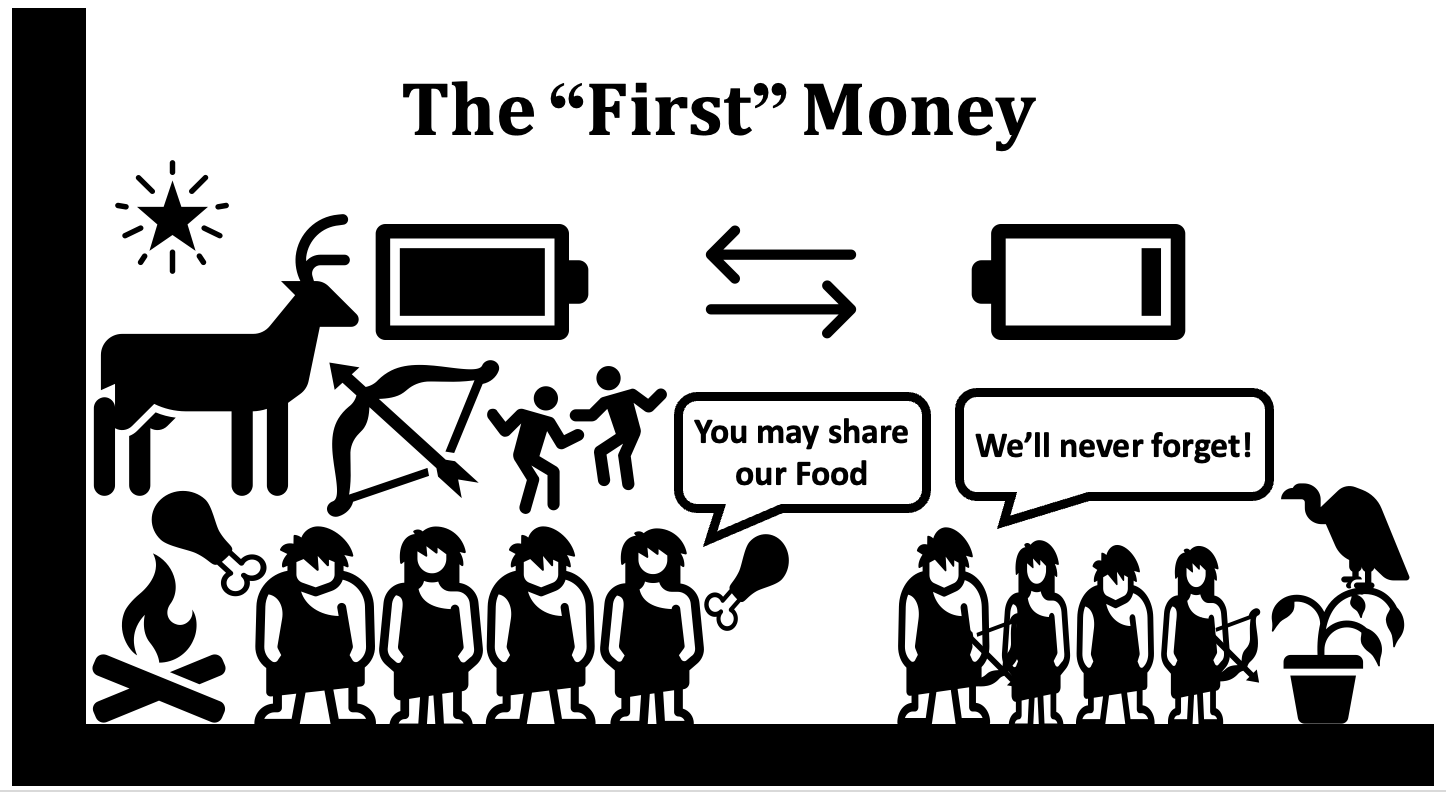
The “first” Money cannot be explored with any level of certainty.
The first known writing was Money, but these early accounting records were not the first Money.
Systems of writing — alphabets and numbers — are how our species collects, stores, retrieves, manipulates and disseminates information. Humans have been artistically scraping cave walls since at least 30,000 BC, but it was another thousand generations before we developed systems of writing.
The Sumerian cuneiform script began in Mesopotamia (now Iraq) around 3400 BC and was initially used exclusively for accounting purposes. The earliest writings were debt records: accounts of who owed what to whom.
Food or Money is what was typically being accounted for, and the purpose of the debt record was to preserve this information over Time.
Recorded debts are different from recorded history because they explicitly connect past acts with promises of future acts. History books contain many facts, but they do not create future obligations, nor can their premises be legally validated or challenged.
Mesopotamian debt records were not merely written — they were highly enforceable.
The “first” enforceable debt records may have begun something like this:
Imagine an ancient human civilization where most men either grow olives or raise cattle, and all are ruled by the same King. Peter is a young olive grower, and Paul is an older, well-established cattle rancher.
They are strangers to each other, but one day Peter approaches Paul with an offer:
“If you give me two of your oxen today, I will give you ten barrels of olive oil in one year. I need the oxen to plough my fields.”
Paul considers this.
He knows that at the local trading market, two oxen can be exchanged for five barrels of olive oil. This was the longstanding rate of exchange. Peter was offering ten. But he would have to wait one year, and Peter might not deliver on his promise.
“This does sound like a good deal, but I cannot accept promises from strangers as payment for my oxen.”
“You mean you haven’t heard of the King’s new debt registry?” Peter responds.
“No” says Paul.
“The recent Food shortages have caused the King to make some changes,” Peter responds. “Rather than using his armies to force more production, he has decided to maintain and enforce debt records for use among his subjects. If I fail to make payment, I will be imprisoned.”
“I see” says Paul. “But what if the King changes the debt records?”
“It would not be in his interest,” Peter replies. “Since the King can tax the entire kingdom, his goal is to maximize Food production. He believes that an honest system of debits and credits is the best way to achieve this.”
“I see” says Paul. “The King wants more meat and oil, regardless of who produces it.”
“Exactly” says Peter. “This system best maximizes the whole.”
“Then we have a deal” says Paul.
They then proceeded to record their agreement at the debt registry.
In this fictional account, the Money was physically manifested in the King’s debt registry, while also living within the minds of Peter and Paul.
But this was not the first Money.
Humans have been collaboratively intermediating between Time and Food long before the first enforceable debt records.
Non-enforceable debt records came before this, which lacked the oversight of a central authority. But some earlier human cultures may have been less averse to accepting promises from strangers as payment for goods.
Many North American indigenous cultures had their own systems of Money involving elaborate strings of seashells or beads, to keep track of their debts.
A credit system based on unenforceable promises might have worked for some earlier cultures, where notions of honor or the supernatural may have had a regulating effect. But the lack of enforceability could also have led to occasional breakdowns of trust.
Before enforceable or unenforceable recorded debts, there were unrecorded promises living only within the minds of creditors and debtors — and perhaps a tribal leader.
This was the “first” Money.
When humans lived in small nomadic groups, leaders could be aware of all internal agreements and could resolve any disputes.
But rival tribes may have transacted with each other implicitly. For example, imagine this scenario:
After a successful hunt, Tribe A has an abundance of meat.
Meanwhile, Tribe B, living on the other side of the mountain, was having their worst luck in years. After many days without animal protein, their hunters had become weak and were in poor physical condition — They were running out of Time.
Tribe B were severely disoriented when the scent of Food led them to Tribe A’s feast.
Not accustomed to sharing, Tribe A’s hunters aimed their weapons towards the disheveled intruders — until their own leader yelled “stop!”
Recognizing that they too may need help one day, Tribe A’s leader decides to share their meat with Tribe B’s hunters — despite protest from his own tribe.
Why give Food away to strangers?
Humans are deeply reciprocal creatures.
Being rescued from starvation leaves a lasting impression. Tribe B will feel compelled to return the favor — should the opportunity ever arise.
Our species’ survival instincts predate recorded debts or written laws.
This was a risk management decision.
Tribe A was exchanging some of their Food for an unwritten “credit:” the possibility of receiving similar help in the future.
Our species’ greater ability to integrate the past and future into our decision-making made it possible for Tribe A’s leader to decide to share with Tribe B in this situation.
Animals do not share their Food with strangers.
This is what it means to intermediate between Time and Food.
The “first” Money was an unwritten, unenforceable agreement existing within the minds of creditors (Tribe A) and debtors (Tribe B). There was no power to enforce debts — only a shared understanding based on short and long-term survival instincts.
The “first” Money was an adaptive human behavior. It was our response to the two timeless questions: What is possible? Which is best?
The concept of Money was born when humans began to intermediate between Time and Food.
Very interesting perspective. One I hadn’t thought of before reading your post. It seems we may still be experiencing this phenomenon - using credit cards to buy groceries.